Ship AI voice agents that handle real calls
A hands-on, code-first curriculum that takes you from STT→LLM→TTS fundamentals to a production-deployed inbound and outbound voice agent — using real tools like Vapi, Twilio, ElevenLabs, and Deepgram, with no prior voice-AI experience required.

I built this course to give you the mental model first and the working code second — because one without the other is how agents end up quietly turned off.— Dotimi
What you'll learn
What you'll be able to do
- Design a complete AI voice agent architecture covering STT, LLM reasoning, and TTS pipeline layers
- Build and deploy a live inbound phone agent using a modern voice-AI platform such as Vapi or Retell
- Write effective system prompts and conversation flows that handle interruptions, edge cases, and caller drop-offs gracefully
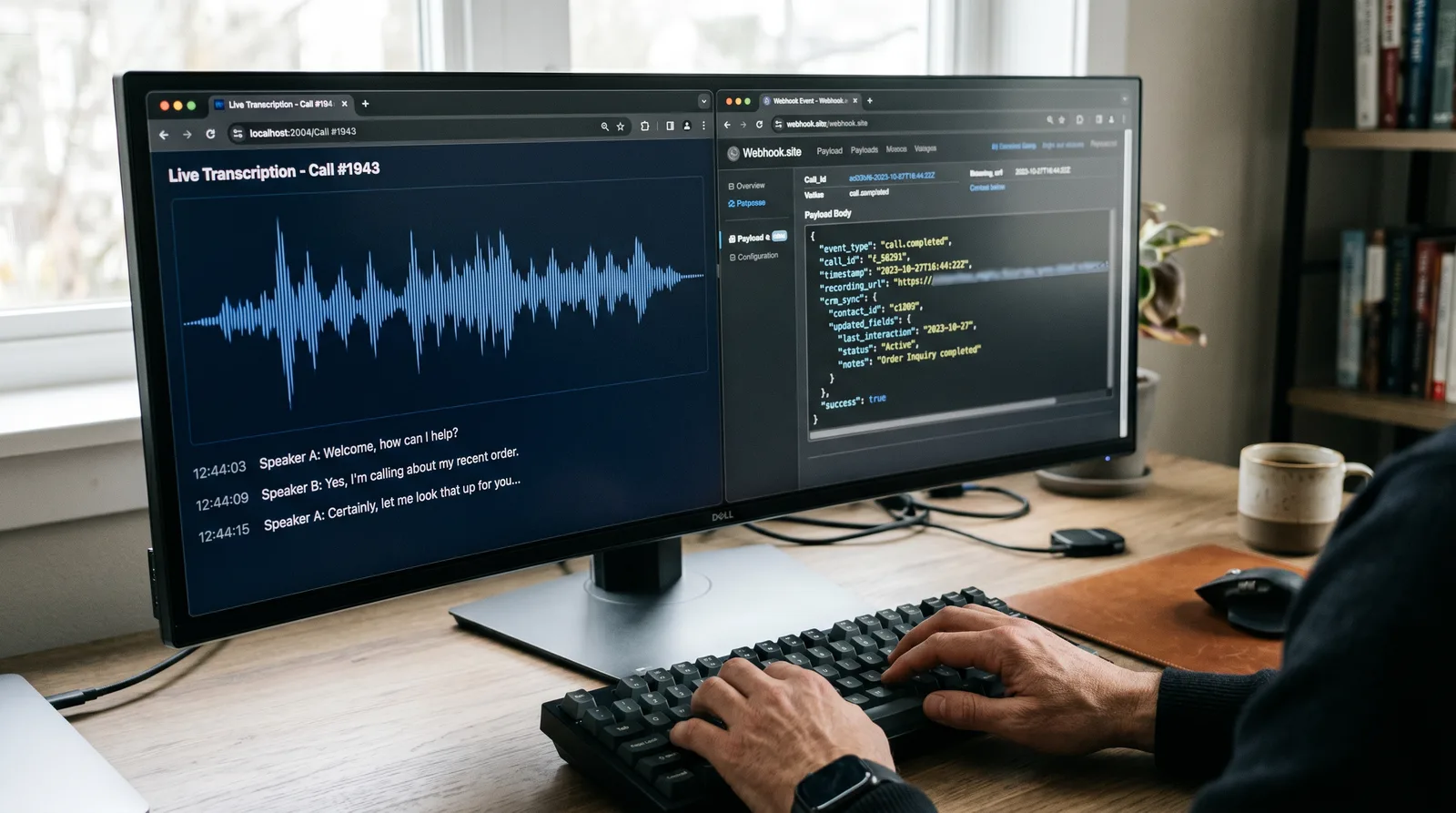
- Integrate voice agents with external tools — CRMs, calendars, and webhooks — to trigger real-world actions mid-call
- Evaluate and swap voice, transcription, and model providers based on latency, cost, and accuracy trade-offs
- Launch a production-ready outbound calling campaign with error handling, compliance guardrails, and call analytics
How it works
A school that adapts to you
This isn't a set of static videos. Every lesson is generated live and tuned to where you actually are.
We learn your level
A quick placement check tailors your starting point so you're never bored or lost.
Lessons adapt as you go
Each lesson is written for your pace and your goal, adjusting as your skills grow.
Your AI coach keeps you moving
Checkpoints, feedback, and gentle nudges turn progress into a real result.
The curriculum
What's inside your school
6 modules · 17 lessons

How AI Voice Agents Actually Work
Establish a rock-solid mental model of the full voice-AI stack before any code is written. Learners leave this module able to read an architecture diagram, articulate latency budgets at each pipeline layer, and make informed provider shortlists — prerequisite knowledge that every later module builds on.
- 1.1The STT → LLM → TTS Pipeline UnpackedIncluded
- 1.2Telephony, Streaming, and Real-Time ConstraintsIncluded
- 1.3Provider Landscape and Trade-off FrameworksIncluded
Designing Conversations That Actually Work
Shift from architecture to conversation design. Learners master the craft of writing system prompts, mapping multi-turn flows, and anticipating the messy realities of real phone calls — interruptions, silence, confused callers, and unexpected drop-offs. Strong conversation design is the highest-leverage skill for voice-agent quality and is correctly placed before any building begins.
- 2.1System Prompt Engineering for VoiceIncluded
- 2.2Conversation Flow Mapping and State ManagementIncluded
- 2.3Handling Interruptions, Silence, and Edge CasesIncluded
Building Your First Inbound Voice Agent
Hands-on build module: learners go from zero to a fully functional, publicly callable inbound agent. The module intentionally starts with the simplest possible working agent before layering in a complete real-world use case, ensuring confidence is built incrementally. Completion of this module directly satisfies the 'build and deploy a live inbound phone agent' outcome.
- 3.1Platform Setup and Your First Live CallIncluded
- 3.2Building a Complete Inbound Use CaseIncluded
Integrating Tools, CRMs, and External Systems
Voice agents become truly powerful when they can take action mid-call — looking up a caller's account, booking a slot in a calendar, or firing a webhook that triggers a downstream workflow. This module covers the full integration stack: function calling, CRM/calendar connectors, and post-call automation. Placed after the inbound build so learners integrate into a working agent rather than an abstract one.
- 4.1Function Calling and Mid-Call Tool UseIncluded
- 4.2CRM and Calendar IntegrationsIncluded
- 4.3Webhooks, Post-Call Automation, and Data PipelinesIncluded
Outbound Calling Campaigns
Design and launch agents that initiate calls rather than receive them — a fundamentally different UX and operational challenge. Covers outbound script architecture, campaign orchestration, retry and error-handling logic, and the legal and ethical guardrails that are non-negotiable for any real-world deployment. Placed after integrations so outbound agents can immediately leverage CRM data and webhooks.
- 5.1Outbound Agent Design and Script ArchitectureIncluded
- 5.2Campaign Launch, Retry Logic, and Error HandlingIncluded
- 5.3Compliance, Consent, and Ethical GuardrailsIncluded
Production Readiness, Monitoring, and Iteration
The final module closes the loop: learners treat their voice agent as a live product, not a prototype. Covers quality evaluation frameworks, systematic provider swapping, production monitoring pipelines, and the continuous-improvement loop that separates a deployed demo from a reliable business system. Directly satisfies the 'evaluate and swap providers' and 'production-ready outbound campaign' outcomes.
- 6.1Evaluating Voice Agent QualityIncluded
- 6.2Latency Optimization and Provider SwappingIncluded
- 6.3Production Monitoring, Alerting, and the Iteration LoopIncluded
Who it's for
Is this you?

Backend developers
You're comfortable with APIs and want to add voice agent capabilities to your skillset using the same engineering rigor you apply to everything else.

Technical founders
You're building a product that needs a voice layer and want to architect it correctly the first time instead of refactoring a fragile demo into production.

AI/ML engineers
You know LLMs well but haven't worked with real-time telephony pipelines and need the STT, TTS, and streaming constraints to complete your voice-AI picture.

Freelance dev consultants
Your clients are asking for AI voice agents and you want the delivery playbook — architecture, integrations, compliance, and all — before you take the next brief.

Product engineers
You sit at the intersection of product and code and need to understand voice agent trade-offs deeply enough to spec, build, and ship them without a dedicated AI team.

Technical entrepreneurs
You're exploring voice AI as a business opportunity and need a production-grounded foundation — not hype — to validate and build your first deployable agent.
Questions
Frequently asked
Your teacher
A note from your teacher

Dotimi
If you've been watching the voice AI space and thinking "I should be building this" — you're right, and you're not as far away as you think.
The honest gap isn't intelligence or ambition. It's that most of the available material either stops at a five-minute demo or jumps straight into platform-specific tutorials without explaining the underlying architecture. You end up with something that works once, on a good call, in a quiet environment — and then breaks in production in ways you don't have the mental model to debug. I built this course because that gap was real and costly, and I wanted to close it properly.
Here's how Voice Agent Lab is different: we start with the pipeline — STT, LLM reasoning, TTS — and we treat telephony and real-time streaming constraints as first-class concerns, not footnotes. You'll understand why latency compounds at each layer, why interruption handling is hard, and how to write system prompts that hold up when callers go off-script. That foundation makes every platform tutorial stickier, because you know what the platform is actually doing underneath.
From there, we build. You'll set up a live inbound agent, integrate it with real external systems (CRMs, calendars, webhooks), and then ship an outbound campaign with proper retry logic and compliance guardrails. These aren't toy examples — they're the patterns that show up in real business deployments. And in the final module, we cover what most courses skip entirely: how to monitor, evaluate, and systematically improve a voice agent once it's live. Because the agents that stay in production are the ones someone is actually watching.
I'm not going to oversell what you'll walk away with. You'll walk away with a deployed agent, a provider trade-off framework you can reuse, and the architecture judgment to build the next one faster. That's the goal. Let's get to work.
— Dotimi
Start your journey today
Join get instant access — learn at your own pace with an AI coach in your corner.
$79/mo
Recurring billing · cancel anytime
Secure checkout · Instant access
- 6 modules, 17 lessons
- AI-adaptive lessons tuned to your level
- Quizzes & checkpoints to lock in progress
- Your own AI learning coach
- Learn on any device, at your pace
- Full access for as long as you're subscribed