
Build worlds only you could imagine
Learn to use AI as a creative collaborator — not a replacement — to build immersive story worlds with rich cultures, histories, magic systems, and characters that are unmistakably yours. Go from blank page to a complete world bible, faster than you ever thought possible.
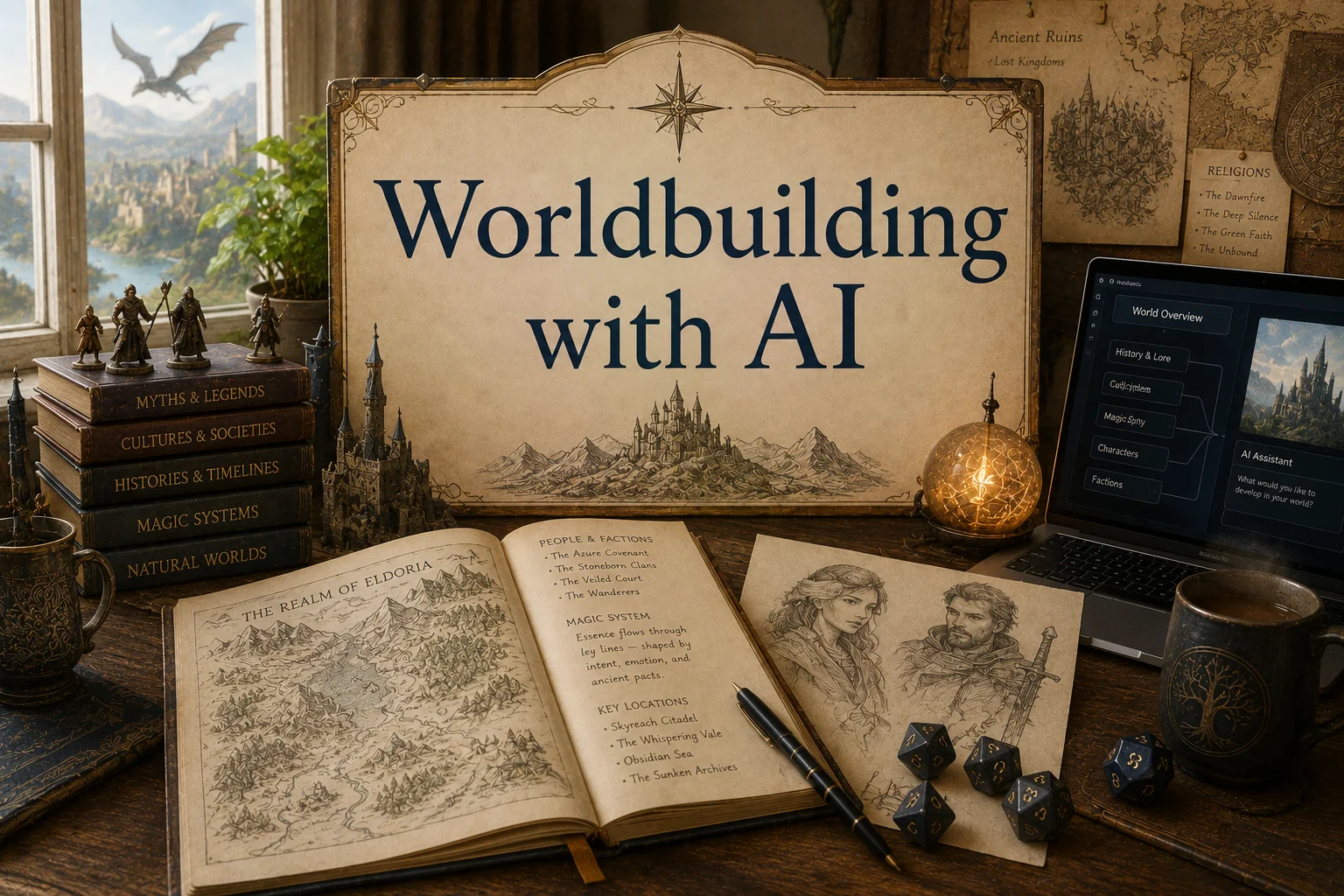
"AI should make your creative voice louder, not replace it — and that's exactly what I'll show you how to do."
— Carla Paton
What you'll learn
What you'll be able to do
- Use AI as a guided brainstorming partner to generate original settings, cultures, and histories without falling back on genre clichés
- Design internally consistent geography, ecosystems, political systems, and economies that make your world feel physically and socially real
- Build compelling magic systems or speculative technologies with clear rules, costs, and limitations that serve your story's themes
- Develop richly detailed cultures — belief systems, rituals, languages, naming conventions, social structures — that shape believable characters
- Assemble a comprehensive, searchable world bible that tracks timelines, continuity, and lore across your entire manuscript
- Weave worldbuilding seamlessly into narrative prose, revealing your setting naturally without exposition dumps
How it works
A school that adapts to you
This isn't a set of static videos. Every lesson is generated live and tuned to where you actually are.
We learn your level
A quick placement check tailors your starting point so you're never bored or lost.
Lessons adapt as you go
Each lesson is written for your pace and your goal, adjusting as your skills grow.
Your AI coach keeps you moving
Checkpoints, feedback, and gentle nudges turn progress into a real result.
The curriculum
What's inside your school
6 modules · 27 lessons

AI as Your Worldbuilding Partner
Establishes the foundational mindset and practical framework for using AI as a creative collaborator rather than a replacement for imagination. Students learn what AI does well, where it falls short, and how to set up a workflow that keeps their creative voice central from the very first session.
- 1.1Why AI Works Well for BrainstormingIncluded
- 1.2Avoiding Generic Fantasy — Training Your Originality RadarIncluded
- 1.3Building Instead of Outsourcing CreativityIncluded
- 1.4Choosing the Right WorkflowIncluded
Finding Your World's Core Idea
Before any geography or culture is designed, students identify the thematic and conceptual DNA of their world — the central question it asks, the emotional truth it explores, and the rules that govern its reality. A strong core idea prevents worldbuilding from becoming an unconnected collection of cool details.
- 2.1Theme-First WorldbuildingIncluded
- 2.2High-Concept versus Grounded SettingsIncluded
- 2.3Defining the Rules of Your UniverseIncluded
- 2.4Asking Better Creative QuestionsIncluded
Geography, Environment, and History
Grounds the world in physical and temporal reality. Students design the landscape, climate, and ecosystems that shape how people live, then build the historical forces — myths, eras, wars, and turning points — that explain why the world is the way it is now. Physical reality and history are taught together because geography determines history.
- 3.1Continents, Climates, and Natural ResourcesIncluded
- 3.2Flora, Fauna, and EcosystemsIncluded
- 3.3Founding Myths and Historical ErasIncluded
- 3.4Wars, Heroes, Villains, and Cultural Turning PointsIncluded
Cultures, Societies, and Power
Builds the human (or non-human) layer of the world: the belief systems, customs, social structures, political arrangements, and economic forces that determine how people live, what they value, and what they fight over. This module ensures the world feels socially as well as physically real.
- 4.1Religion, Belief Systems, and RitualIncluded
- 4.2Customs, Family Structures, and Social ClassIncluded
- 4.3Political Systems, Governments, and LawsIncluded
- 4.4Trade, Economics, and Sources of ConflictIncluded
- 4.5Diplomacy and the Geography of ConflictIncluded
Magic, Technology, Characters, and Naming
Builds the speculative and human layers that sit on top of the world's physical and social foundations. Magic systems and technologies are designed with rigorous internal logic; characters are grounded in their cultural context; and naming systems give the world a consistent linguistic identity. These elements are sequenced together because naming, characterisation, and speculative systems all draw on the cultural and historical work done in previous modules.
- 5.1Hard versus Soft Magic and Speculative TechnologyIncluded
- 5.2Costs, Limitations, and Avoiding Deus Ex MachinaIncluded
- 5.3Creating Believable Character BackgroundsIncluded
- 5.4Factions, Relationships, and Cultural Influence on PersonalityIncluded
- 5.5Naming Systems for People, Places, and ThingsIncluded
Your World Bible and the Leap to Story
Consolidates everything built across the course into a functional, searchable world bible, then makes the crucial transition from worldbuilding to storytelling — teaching students to weave their world into narrative prose naturally, revise with AI assistance, and prepare a manuscript that trusts readers to discover the world rather than receive a lecture about it.
- 6.1Organising Your World BibleIncluded
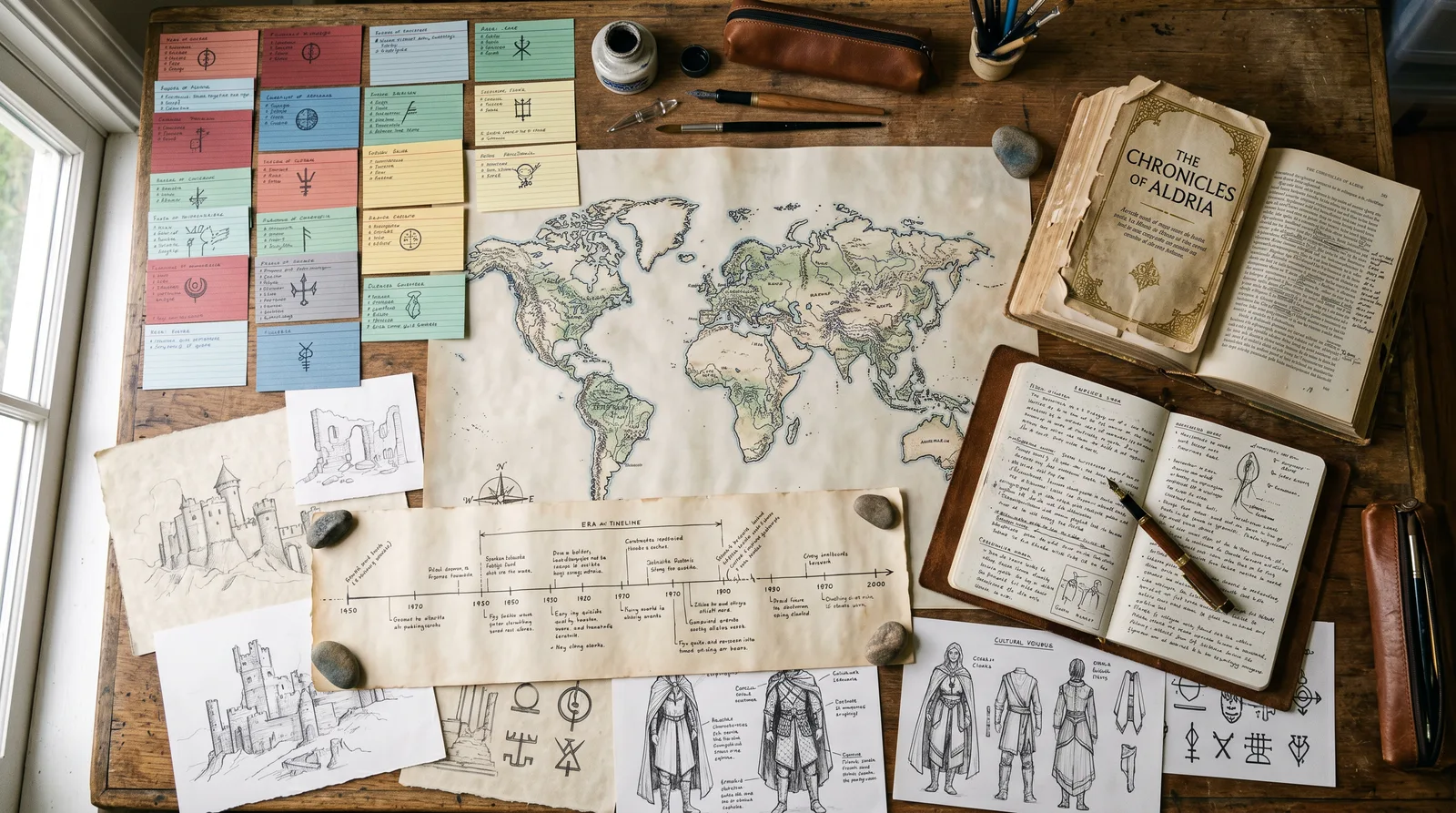
- 6.2Timelines, Glossaries, and Visual ReferencesIncluded
- 6.3Continuity Tracking with AIIncluded
- 6.4Revealing the World Naturally — No Exposition DumpsIncluded
- 6.5Revising with AI and Preparing Your ManuscriptIncluded
Who it's for
Is this you?

Debut fantasy writers
You have a vivid world in your head but no system for getting it onto the page with structural coherence — this school gives you that system, from geography to world bible.

Working sci-fi authors
You need speculative technologies and social structures that feel rigorously thought-through, and a faster way to keep continuity consistent across a complex manuscript.

Alternate-history novelists
You want to diverge from real history with confidence, building plausible political systems and cultural turning points that hold up under a reader's scrutiny.

Genre veterans with AI scepticism
You've built worlds the old way and want to know how AI can genuinely accelerate your process without flattening the originality that defines your work.

Pantsers going series-length
You've been improvising your world as you write and now face a continuity tangle — the world bible module alone will transform how you manage a multi-book project.

Creative writing students
You're studying the craft and want a rigorous, practical framework for speculative worldbuilding that goes far beyond what most writing programmes cover.
Questions
Frequently asked
Your teacher
A note from your teacher

Carla Paton
If you've ever stared at a blank document labelled "World Notes" and felt the weight of everything you don't know yet about your story's world — where the borders are, how the magic works, why these people worship that god, what they eat for breakfast — I want you to know that feeling is completely normal. It's not a sign that you're not a real worldbuilder. It's a sign that you care about getting it right.
I built World Architect because I kept running into the same problem in my own work and in the writing of people I know: the world exists in your head as a feeling, an atmosphere, a handful of vivid images — but translating that into something structurally sound enough to carry a whole novel is a different skill entirely. Geography has to make ecological sense. Cultures have to have reasons for their rituals. Magic systems have to have rules or they stop mattering. And all of it has to disappear into the prose so naturally that the reader never feels lectured. That's a lot to hold at once.
What changed my process — and what this school is built around — is learning to use AI not as a ghostwriter, but as a thinking partner. A really good brainstorming collaborator who never gets tired, never judges a half-formed idea, and can help you stress-test a political system or generate a dozen naming conventions in the time it used to take to fill a single index card. The catch is learning to drive that conversation rather than just accepting whatever comes out. The school teaches you exactly that: how to ask better creative questions, how to spot when AI is handing you a cliché dressed up as originality, and how to keep your creative instincts firmly in the driver's seat.
Every module is grounded in real craft decisions — the kind you'll face when writing an actual manuscript. We go from the tectonic and ecological logic of your geography all the way through cultural belief systems, economic conflicts, magic or speculative technology, character backgrounds, and finally into your world bible and your prose. Nothing is abstract theory. Everything connects back to story.
Whether you're a first-time fantasy writer trying to build your opening world from nothing, or a genre veteran who has three novels drafted and a continuity problem they've been avoiding, World Architect meets you where you are. Come with your half-formed idea, your sprawling notes, or just your conviction that you have a world worth building. We'll make it real — and we'll make it unmistakably yours.
— Carla Paton
Start your journey today
Join 1 others and get instant access — learn at your own pace with an AI coach in your corner.
$29/mo
Recurring billing · cancel anytime
Secure checkout · Instant access
- 6 modules, 27 lessons
- AI-adaptive lessons tuned to your level
- Quizzes & checkpoints to lock in progress
- Your own AI learning coach
- Learn on any device, at your pace
- Full access for as long as you're subscribed