Finally understand the brain inside your head
A warm, jargon-free journey through real neuroscience — from your very first neuron to the science of how brains heal — no textbook required, just genuine curiosity.

"The real science of the brain is so much stranger and more wonderful than the myths — I just want to make sure everyone gets to hear it."— Jill Lien Big Horn Wellness
What you'll learn
What you'll be able to do
- Confidently explain what each major brain region actually does — lobes, limbic system, cerebellum, and brainstem — and debunk the most persistent myths, including the left-brain/right-brain personality myth.
- Describe how the two hemispheres divide and share labour, how the corpus callosum connects them, and what split-brain research really revealed about human consciousness.
- Trace the brain's entire developmental journey — from the embryonic neural tube to the fully mature prefrontal cortex at age 25 — and explain why teenagers think and behave the way they do.
- Explain how distributed neural networks — not isolated regions — produce movement, language, memory, and emotion, and why 'no brain area works alone' is the single most important insight in modern neuroscience.
- Describe neuroplasticity in plain language: how neurons reroute, adapt, and take over neighbouring functions after stroke or injury, and why this biological brilliance is the foundation of rehabilitation and recovery.
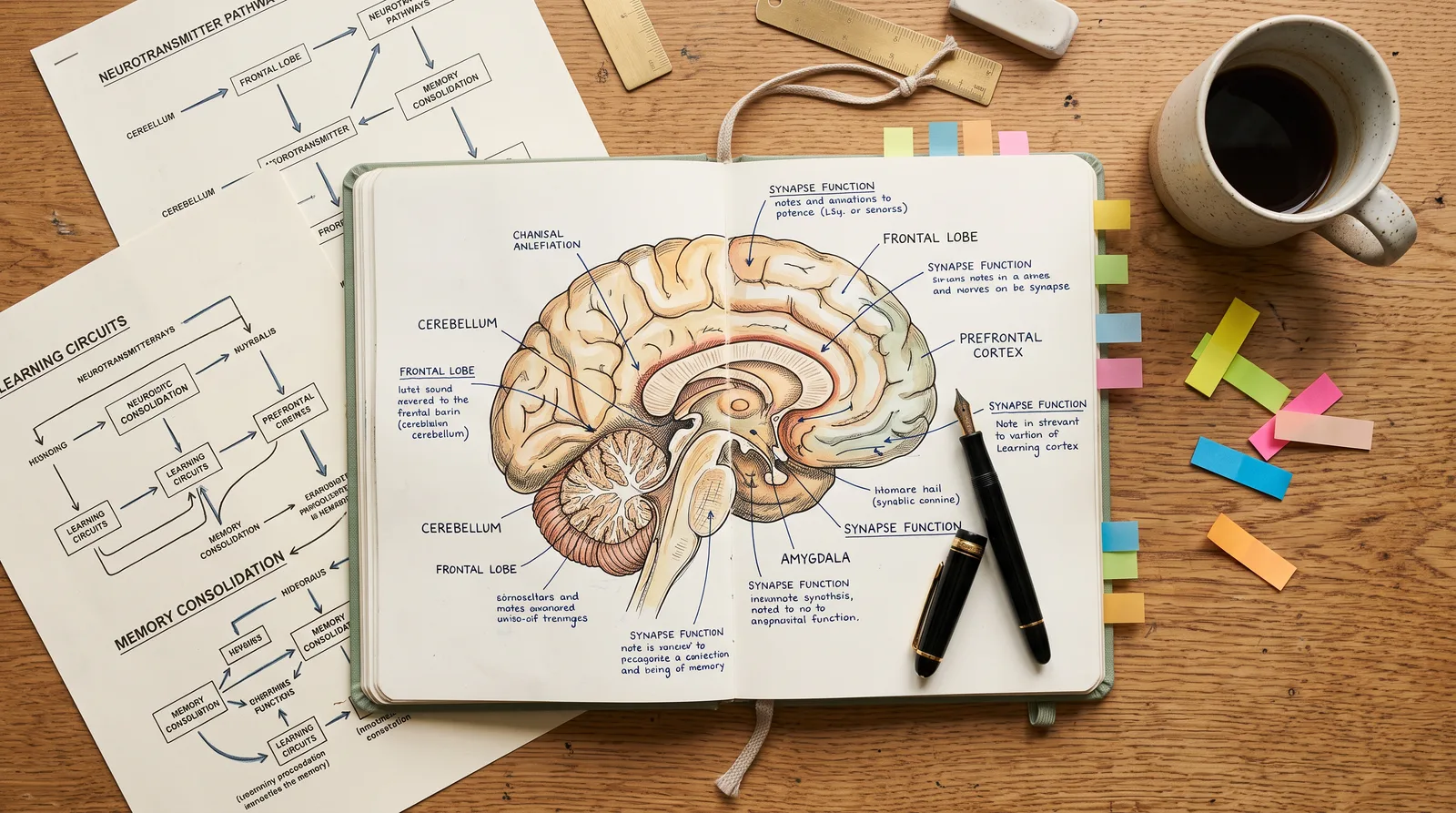
- Read and interpret illustrated brain diagrams, developmental timelines, and neural-network flowcharts, and use printable reference handouts to retain and share what they've learned.
How it works
A school that adapts to you
This isn't a set of static videos. Every lesson is generated live and tuned to where you actually are.
We learn your level
A quick placement check tailors your starting point so you're never bored or lost.
Lessons adapt as you go
Each lesson is written for your pace and your goal, adjusting as your skills grow.
Your AI coach keeps you moving
Checkpoints, feedback, and gentle nudges turn progress into a real result.
The curriculum
What's inside your school
6 modules · 28 lessons

Meet Your Brain: A Plain-Language Orientation
Gives learners a confident, jargon-free first look at the brain's overall shape, scale, and organisation before any deep dives begin.
- 1.1Why Your Brain Is Worth UnderstandingIncluded
- 1.2The Big Picture: Size, Shape, and Basic LayoutIncluded
- 1.3Brain Cells 101: Neurons and Their NeighboursIncluded
- 1.4How Neurons Talk: Signals, Synapses, and NeurotransmittersIncluded
A Grand Tour of the Brain's Regions
Walks learners through every major brain area — lobes, cerebellum, brainstem, and limbic system — with plain-language descriptions, diagrams, and printable handouts for each.
- 2.1The Cortex and Its Four LobesIncluded
- 2.2The Frontal Lobe: Your Inner Chief ExecutiveIncluded
- 2.3Parietal, Temporal, and Occipital Lobes: Senses, Sound, and SightIncluded
- 2.4The Cerebellum and Brainstem: Autopilot and Life SupportIncluded
- 2.5The Limbic System: Emotion, Memory, and SurvivalIncluded
Two Sides of One Brain: Hemispheres, Myths, and Reality
Examines what the left and right hemispheres genuinely specialise in, how the corpus callosum connects them, and what split-brain science actually proved.
- 3.1Left Brain, Right Brain: The Real StoryIncluded
- 3.2The Corpus Callosum: The Brain's Information SuperhighwayIncluded
- 3.3Split-Brain Research and What It Taught Us About ConsciousnessIncluded
- 3.4Busting the Biggest Brain MythsIncluded
Networks in Action: How Brain Regions Work Together
Shows how movement, thought, emotion, memory, and language each emerge from collaborative neural networks rather than any single region working alone.
- 4.1No Region Is an Island: The Network PrincipleIncluded
- 4.2How You Move: The Motor Network in ActionIncluded
- 4.3How You Remember: Memory Networks and the HippocampusIncluded
- 4.4How You Feel: Emotion Networks and the AmygdalaIncluded
- 4.5How You Speak and Understand Language: Broca, Wernicke, and BeyondIncluded
The Developing Brain: Conception to Age 25
Traces the brain's entire developmental arc — from the embryonic neural tube through childhood, the teenage years, and finally full maturity at the mid-twenties — with an illustrated timeline throughout.
- 5.1From Neural Tube to Newborn BrainIncluded
- 5.2The Neuron Explosion: Brain Growth in the Womb and Early ChildhoodIncluded
- 5.3Pruning and Myelination: The Brain Gets EfficientIncluded
- 5.4The Teenage Brain: Risk, Reward, and the Unfinished Prefrontal CortexIncluded
- 5.5Full Maturity at 25: The Prefrontal Cortex Completes Its JourneyIncluded
The Brilliant, Adaptable Brain: Neuroplasticity and Recovery
Reveals how the brain rewires, reroutes, and recovers after damage — explaining the cellular mechanisms of neuroplasticity and how rehabilitation exploits them.
- 6.1What Neuroplasticity Actually MeansIncluded
- 6.2How Neurons Adapt: Strengthening, Rerouting, and Taking OverIncluded
- 6.3When the Brain Is Damaged: Stroke, Injury, and What Happens NextIncluded
- 6.4Rehabilitation and Recovery: Training the Brain to RewireIncluded
- 6.5Your Plastic Brain Throughout Life: Learning, Habit, and Lifelong ChangeIncluded
Who it's for
Is this you?

Lifelong learners
You've always been curious about how the mind works and want the real science told in a way that finally makes it all click.

Caregivers & family supporters
Whether you're supporting a stroke survivor or a loved one with a brain injury, understanding neuroplasticity and recovery changes everything about how you help.

Parents of teenagers
The section on the unfinished prefrontal cortex alone will transform the way you understand — and respond to — adolescent behaviour.

Classroom educators
From early-childhood pruning to the teenage reward system, the brain's developmental arc gives you a richer scientific foundation for the way your students learn.

Myth-busters & sceptics
You've suspected the left-brain/right-brain personality thing was nonsense for years — this course confirms it, and replaces the myths with what research actually found.

Wellness & self-improvement seekers
Understanding how habit, learning, and neuroplasticity work at a biological level gives your personal-growth efforts a grounded, science-backed foundation.
Questions
Frequently asked
Your teacher
A note from your teacher
Jill Lien Big Horn Wellness
If you've ever caught yourself wondering why you can't remember a name five seconds after you heard it, or why a piece of music can drag a twenty-year-old memory straight to the surface, or what on earth is actually happening in a teenager's head — you're already the kind of person this course was made for.
Most of us were never really taught how our own brains work. We picked up fragments — a documentary here, a pop-science headline there — but the full picture never quite came together. And so we carry around half-myths (ten percent of your brain, left-brained creative types, right-brained logical ones) without ever getting the genuinely astonishing true story. That's not a gap in intelligence. It's just a gap nobody ever bothered to fill, in language that actually landed.
That's exactly what I set out to do with Your Brilliant Brain. I wanted to build the course I wished had existed — one that takes the real science seriously without hiding it behind Latin terminology and passive-voice textbook prose. So we start where it makes sense to start: with the cells themselves, with what a neuron actually is and how it fires, and with a clear map of the brain's major regions. Then we build outward. You'll discover why the cerebellum and brainstem handle the things you never have to think about, why the limbic system sits at the intersection of emotion, memory, and survival, and why the frontal lobe is the last part of the brain to fully come online — not until your mid-twenties.
The section I find people connect with most deeply, though, is neuroplasticity. The idea that the brain can reroute itself after a stroke — that neighbouring neurons can literally learn to take over the functions of damaged ones, that rehabilitation is, at its core, the act of training a biological system to redraw its own wiring diagram — that's not a metaphor. That's what's actually happening. And once you understand it at that level, recovery stops looking like a mystery and starts looking like biology doing something extraordinary.
I've designed every part of this course so that when you finish, you can do something with what you've learned — explain it to a family member, use it in a classroom, apply it to understanding someone you care for, or simply carry it as a new way of seeing yourself. The illustrated diagrams, the developmental timelines, the printable handouts — they're all there so the knowledge stays with you.
Come as you are. Bring your questions. The brain is the most complex thing we've ever tried to understand, and it turns out the story is even better than the myths.
— Jill Lien Big Horn Wellness
Start your journey today
Join get instant access — learn at your own pace with an AI coach in your corner.
$29.99/mo
Recurring billing · cancel anytime
Secure checkout · Instant access
- 6 modules, 28 lessons
- AI-adaptive lessons tuned to your level
- Quizzes & checkpoints to lock in progress
- Your own AI learning coach
- Learn on any device, at your pace
- Full access for as long as you're subscribed