How to Start a Daily Writing Habit (Even If You've Failed Every Time Before)
Carla Paton · July 28, 2026 · 4 min read
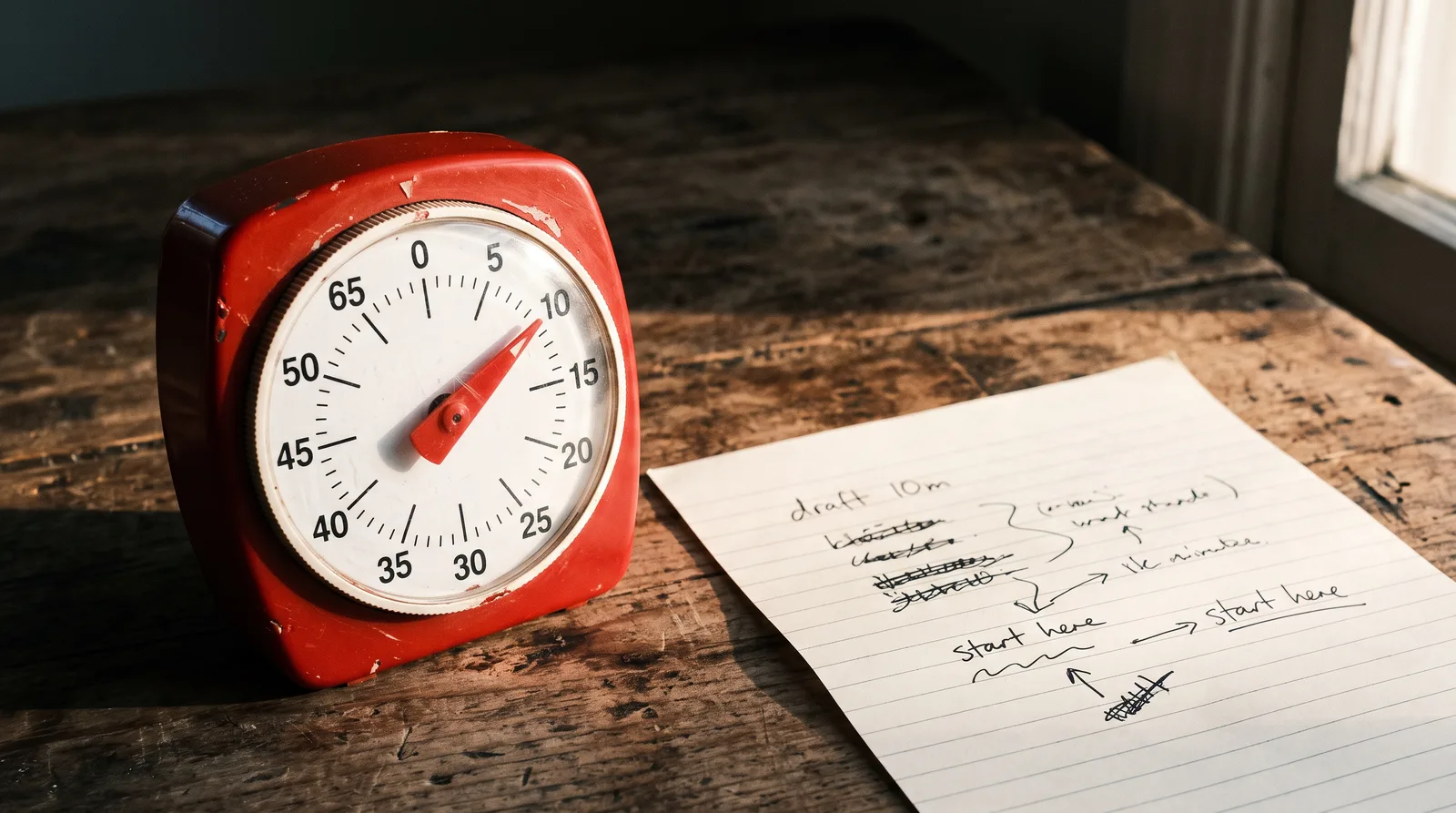
Every January, writers make the same promise to themselves. A notebook. A fresh resolution. This time I'll write every day. By February, the notebook is under a pile of mail.
If that's you, I want to offer you something more useful than encouragement: a diagnosis. Because the problem almost certainly isn't discipline. It's friction.
The Real Reason Daily Writing Doesn't Stick
When a habit fails repeatedly, we blame character. We tell ourselves we're not the kind of person who does the thing. But habit research consistently points somewhere else — to the entry ritual, that tiny moment between intention and action.
Think about how most people set up a daily writing habit. They imagine a scene: coffee brewing, a quiet hour, an inspiring topic, maybe a candle. That scene requires conditions. And conditions are fragile. The morning your kid is sick, the morning you're running late, the morning you're just tired — the conditions aren't there, so the writing doesn't happen. Miss three days and the habit is essentially gone.
The solution isn't willpower. It's lowering the barrier until the habit can survive an imperfect morning.
The One-Page Rule (and Why Timed Writing Changes Everything)
Here's the ritual I want you to try. It has exactly three components:
- One page. Longhand or typed — your choice.
- A timer set for 10 minutes.
- No rereading until the timer stops.
That's it. No topic required. No quality standard. The only rule is that your hand keeps moving.
The timer does something remarkable: it turns an open-ended task (write today) into a closed one (write for 10 minutes). Open-ended tasks are easy to defer because they have no finish line. A 10-minute task has a finish line six minutes closer than you think, and your brain knows it.
The no-rereading rule is equally important. The moment you scroll back to check what you've written, your inner critic wakes up. You start editing instead of generating. The page stalls. Keep moving forward — you can read it all you want when the timer goes off.
How to Build the Habit Loop
A habit has three parts: a cue, a routine, and a reward. Most failed writing habits have a vague cue (sometime in the morning), a demanding routine (write something good), and a delayed or absent reward (maybe someday this will become a book).
Here's how to fix each one:
Make your cue razor-specific. Not in the morning but immediately after I pour my first cup of coffee. The more precisely you attach the new behavior to an existing one, the less it depends on motivation.
Make the routine embarrassingly small. Ten minutes. One page. If you write more, great. But the commitment is ten minutes. You are allowed to write garbage. You are expected to write garbage some days. Garbage is how the habit survives Tuesday.
Give yourself an immediate reward. This sounds silly, but it works: mark the day on a calendar or check it off a list the moment you finish. That small act of completion releases just enough satisfaction to make tomorrow slightly easier. Don't break the chain.
What Happens After 30 Days
Something shifts around the third or fourth week that no amount of prior motivation could manufacture: the writing starts to feel wrong to skip. Not because you're disciplined, but because the neural pathway is worn in. The cue triggers the routine almost automatically. You've become, quietly and without drama, someone who writes every day.
This is when the pages start to get interesting. Not all of them — plenty will still be dross. But buried in that daily accumulation are the sentences you wouldn't have found any other way: the memory you didn't know you were carrying, the image that cracks a poem open, the paragraph that becomes the first paragraph of something real.
You don't get those by waiting for inspiration. You get them by showing up when inspiration hasn't arrived yet.
Where to Go From Here
A timed morning page is the foundation. Once it's solid, you can build on it — shaping those raw pages toward memoir, toward poetry, toward fiction, toward whatever calls you. My courses The Morning Pages and First Draft Finished are both designed to meet you exactly here: at the desk, habit in place, ready to go somewhere specific with the words.
But start with the ten minutes. Start tomorrow morning. One page. Timer on. Hand moving.
You've failed before because the door was too heavy. This time, leave it open.