Methodist vs. Baptist: What Really Separates These Two Traditions?
Gary R Uremovich MS DMin PhD PA (Emeritus) · August 4, 2026 · 4 min read
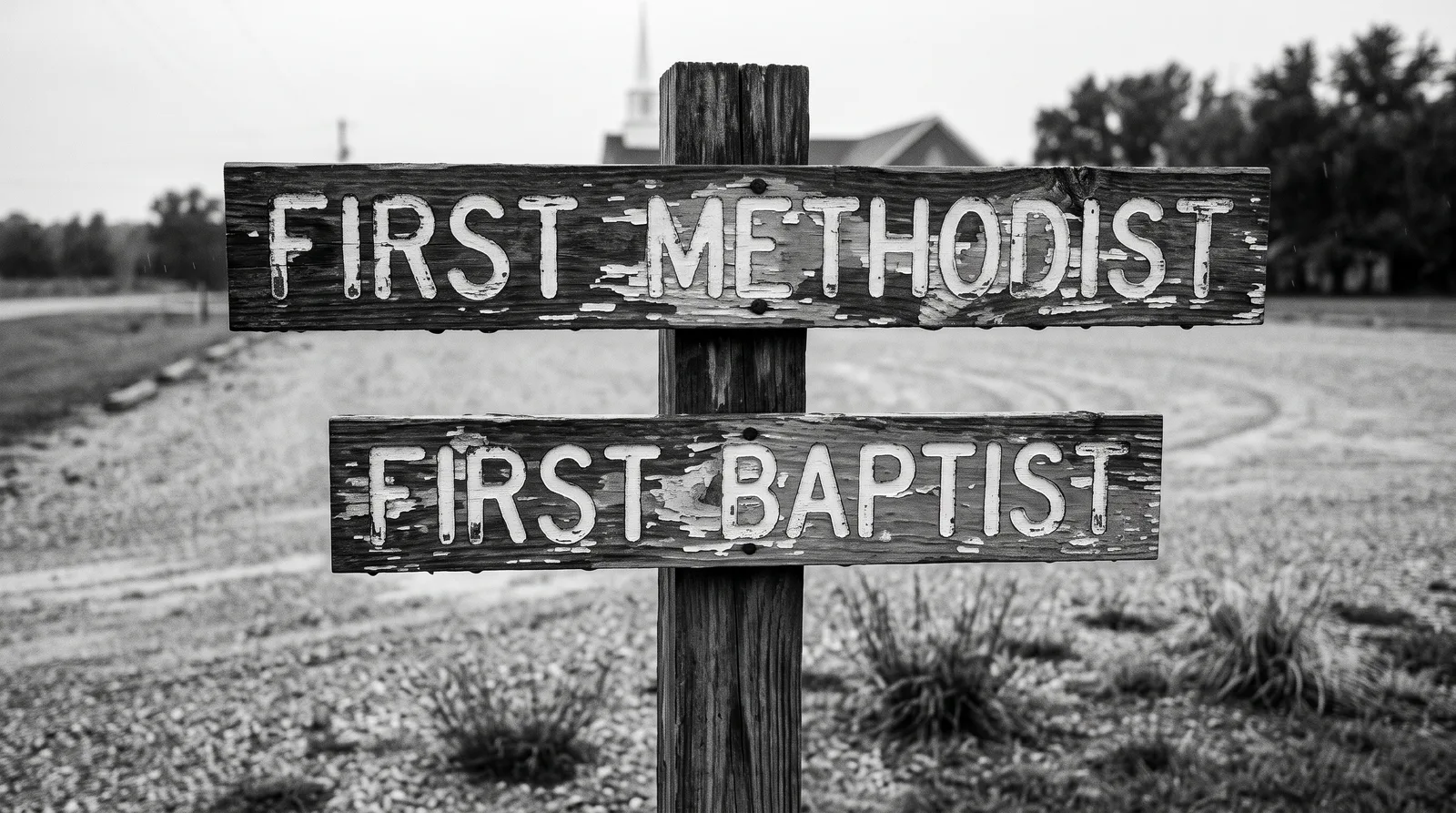
Walk into a Methodist church and a Baptist church on the same Sunday morning and you might notice more similarities than differences — congregational singing, a sermon rooted in Scripture, a warm handshake at the door. But spend a little time inside each tradition's theology and you'll find that these two branches of Protestantism are shaped by genuinely distinct convictions about grace, salvation, baptism, and how a church should govern itself.
Neither is simply "more Christian" than the other. But they are meaningfully different, and understanding those differences helps you understand what Methodism is actually for — and why John Wesley's vision still matters today.
The Grace Question: How Much Can You Fall?
This is probably the deepest divide, and it runs straight through the doctrine of salvation.
Most Baptist theology is shaped by Calvinism — specifically, the idea that God's saving grace is irresistible and permanent. If you are truly elect, you cannot ultimately fall away. This is the famous "once saved, always saved" conviction, rooted in the doctrine of the perseverance of the saints.
Wesley rejected this emphatically. Methodist theology holds that grace is prevenient — it goes before us, making faith possible for everyone, not just a predetermined elect. It is also resistible. You can receive it, walk in it, and through persistent, willful rejection, forfeit it. For Wesley, human freedom was not a threat to God's sovereignty; it was the very arena in which genuine love between God and humanity becomes possible. A faith compelled is no faith at all.
This means Methodists live in a theology of ongoing response — salvation is not a one-time transaction but a continuing relationship. Wesley called its goal entire sanctification: a gracious work of God that progressively purifies the heart's motivations, orienting you entirely toward love of God and neighbor. Most Baptist traditions have no equivalent category.
Free Will: Arminian vs. Calvinist Roots
The grace question leads directly here. Baptist theology, especially in its Reformed expressions, tends toward Calvinist understandings of election — God chooses who will be saved, and that choice is unconditional. Human will, in this framework, is too corrupted by sin to initiate a turn toward God.
Methodist theology stands in the Arminian tradition. Named for the Dutch theologian Jacobus Arminius (though Wesley developed it further), Arminianism holds that God's prevenient grace restores enough freedom to every person that genuine choice becomes possible. Nobody is saved against their will, and nobody is damned by divine decree. This is not a soft view of sin — Wesley was quite serious about human fallenness — but it insists that grace is both universal in its reach and personal in its invitation.
Baptism: Mode, Meaning, and Who Qualifies
Ask a Baptist about baptism and the answer will almost always emphasize mode: immersion, and only immersion, as the biblically faithful form. Baptism in most Baptist churches is also believer's baptism — reserved for those who can personally profess faith. Infants are not baptized; they may be dedicated, but the sacrament waits for conscious commitment.
Methodists practice baptism by any mode — sprinkling, pouring, or immersion — and regard the mode as far less theologically significant than the act itself. More importantly, Methodists practice infant baptism. For Wesley and the tradition he shaped, baptism is not merely a public declaration of an already-completed inner decision. It is a sacramental act — a means of grace — in which God is genuinely at work, initiating covenant relationship even before a child can articulate belief. The child is then nurtured toward confirmation, where that covenant is personally owned.
This reflects a fundamentally different theology of the sacraments. Baptists tend toward a memorial or symbolic view. Methodists hold that the sacraments are genuine means of grace — not magic, but real occasions through which God acts on willing hearts.
Church Governance: Connexion vs. Congregation
Baptist churches are, almost by definition, congregationalist. Each local church is self-governing and autonomous. There is no bishop, no binding denominational authority, no higher structure that can tell a local congregation what to do. The gathered believers hold authority together.
Methodism is built on what Wesley called the connexion — an intentional network of accountability and shared mission. United Methodist churches, for example, operate under an episcopal structure: bishops appoint pastors, annual conferences connect local churches, and the denomination speaks and acts together in ways a congregationalist structure cannot. This isn't hierarchy for hierarchy's sake. For Wesley, connectionalism was a missional strategy — the genius that let the early Methodist movement deploy preachers across England and, later, America with remarkable speed and coordination.
Two Traditions, One Family
Methodists and Baptists both love Scripture, proclaim Christ, and long for transformed lives. But they arrive at those shared commitments through different understandings of grace's reach, the human will's role, the sacraments' power, and the church's shape.
Knowing these distinctions isn't about scoring theological points. It's about understanding why your tradition worships, practices, and organizes the way it does — and why those choices aren't arbitrary. They are Wesley-shaped, through and through.
If you want to go deeper into the theological heartbeat of Methodism — Wesley's doctrine of grace, the means of grace, sanctification, and the movement's global legacy — that's exactly what we explore together in The Methodist Way.