Be Formed in the Likeness of Christ — and Learn to Lead Others There
A Master of Arts–level theology school that takes you from biblical foundations to lifelong sanctification — through rigorous doctrine, classical spiritual disciplines, and the full sweep of Christian anthropology. For those who will not settle for thin answers to the deepest question: how does God form a human soul?

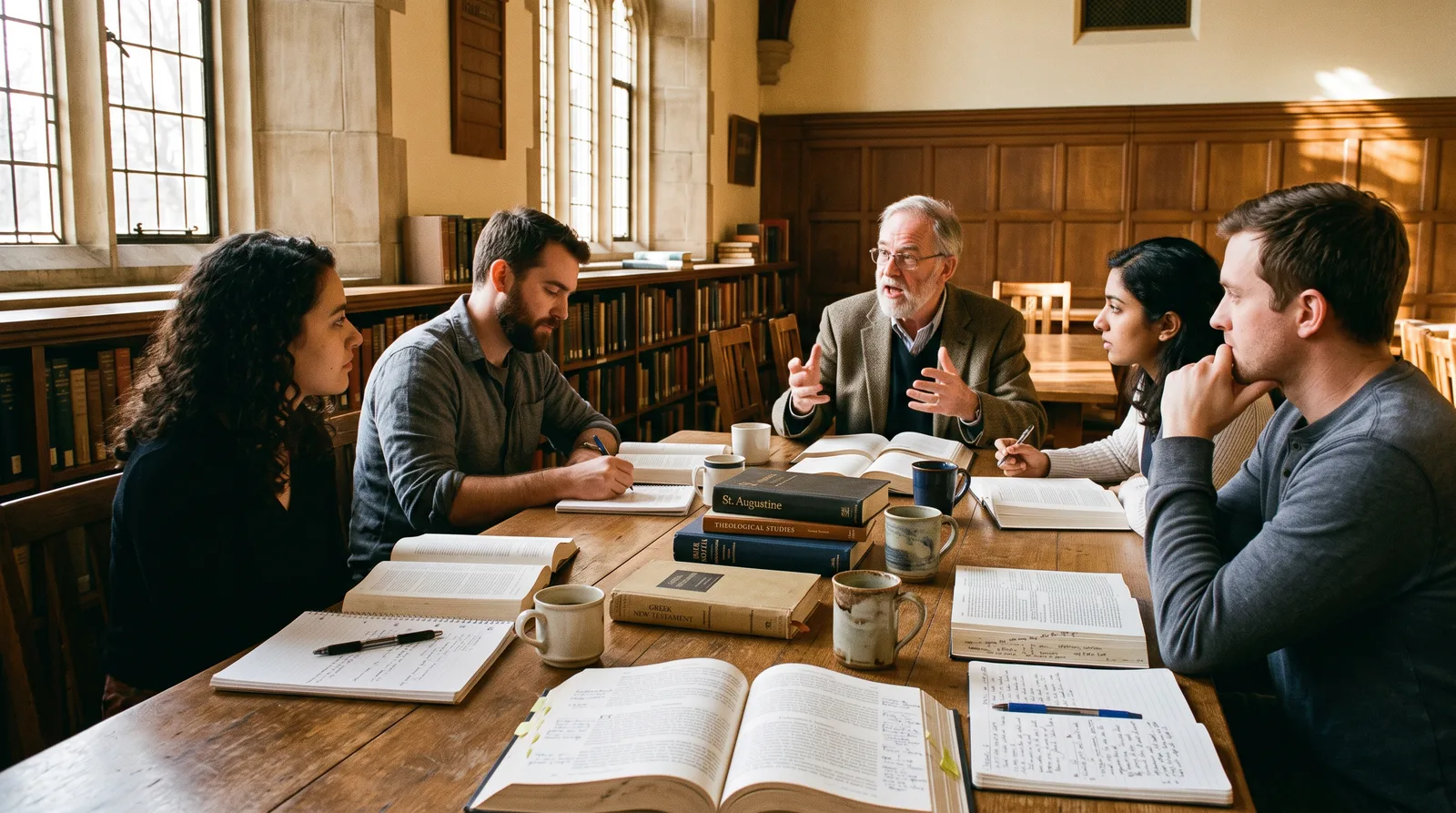
"We do not rush past doctrine to get to practice — because a practice disconnected from its doctrinal roots will eventually become either legalism or sentiment, and neither one forms anyone into the likeness of Christ."
— Timothy Atunnise
What you'll learn
What you'll be able to do
- Articulate a biblically and theologically coherent definition of spiritual formation rooted in the doctrines of creation, fall, redemption, and union with Christ
- Explain the Trinitarian structure of Christian transformation and its implications for the identity and practice of the believer
- Apply a robust Christian anthropology — integrating heart, mind, soul, body, and will — to the diagnosis and direction of spiritual growth
- Distinguish and relate definitive, progressive, and final sanctification within a comprehensive theology of Christlikeness
- Design and evaluate a personal and communal rule of life drawing on classical spiritual disciplines, the sacramental life of the Church, and the theology of grace
- Integrate a theology of suffering, vocation, and eschatological hope into a formation framework for Christian leadership and lifelong discipleship
How it works
A school that adapts to you
This isn't a set of static videos. Every lesson is generated live and tuned to where you actually are.
We learn your level
A quick placement check tailors your starting point so you're never bored or lost.
Lessons adapt as you go
Each lesson is written for your pace and your goal, adjusting as your skills grow.
Your AI coach keeps you moving
Checkpoints, feedback, and gentle nudges turn progress into a real result.
The curriculum
What's inside your school
8 modules · 40 lessons

The Biblical and Theological Foundations of Spiritual Formation
Establishes the scriptural and doctrinal groundwork for understanding spiritual formation within the grand narrative of creation, fall, and redemption.
- 1.1Defining Spiritual Formation in Christian TheologyIncluded
- 1.2The Image of God and the Purpose of Human FormationIncluded
- 1.3Creation, Fall, Redemption, and the Formation of the Human PersonIncluded
- 1.4Union with Christ as the Foundation of Christian TransformationIncluded
- 1.5The Goal of Spiritual Formation: Conformity to the Image of ChristIncluded
The Trinitarian Theology of Spiritual Formation
Develops a robustly Trinitarian account of spiritual formation, grounding transformation in the distinct yet unified work of Father, Son, and Spirit.
- 2.1The Father as the Source and Goal of Spiritual FormationIncluded
- 2.2Jesus Christ as the Pattern and Agent of Spiritual FormationIncluded
- 2.3The Holy Spirit as the Divine Agent of TransformationIncluded
- 2.4Participation in the Life and Fellowship of the Triune GodIncluded
- 2.5Trinitarian Spirituality and the Formation of Christian IdentityIncluded
The Anthropology of Spiritual Formation
Applies a comprehensive biblical anthropology — integrating heart, mind, soul, body, and will — to diagnose the human condition and direct spiritual growth.
- 3.1The Biblical Understanding of the Human PersonIncluded
- 3.2The Heart, Mind, Soul, Body, and Will in Spiritual FormationIncluded
- 3.3Sin, the Fallen Nature, and the Distortion of Human DesireIncluded
- 3.4Regeneration and the Beginning of the Formed Christian LifeIncluded
- 3.5The Integration of Spiritual, Moral, Emotional, and Relational FormationIncluded
Sanctification and Transformation into Christlikeness
Provides a systematic and pastoral theology of sanctification, distinguishing its phases and relating grace to human cooperation in the pursuit of holiness.
- 4.1The Doctrine of Sanctification and Christian FormationIncluded
- 4.2Definitive, Progressive, and Final SanctificationIncluded
- 4.3Putting Off the Old Self and Putting On the New SelfIncluded
- 4.4The Fruit of the Spirit and the Formation of Christian CharacterIncluded
- 4.5Grace, Human Cooperation, and the Process of Spiritual MaturityIncluded
Scripture, Prayer, and the Spiritual Disciplines
Examines the classical spiritual disciplines as grace-mediated means of formation, grounding each practice in sound theological and scriptural warrant.
- 5.1Scripture as the Formative Word of GodIncluded
- 5.2Prayer and Communion with GodIncluded
- 5.3Fasting, Solitude, Silence, and Spiritual AttentivenessIncluded
- 5.4Worship, Confession, Meditation, and Other Formative PracticesIncluded
- 5.5Spiritual Disciplines as Means of Grace Rather Than Means of MeritIncluded
The Church and the Communal Dimensions of Spiritual Formation
Recovers the ecclesial context of formation, showing how corporate worship, sacraments, discipleship, and shared ministry form the Body of Christ.
- 6.1The Church as a Community of Spiritual FormationIncluded
- 6.2Worship, Preaching, Baptism, and the Lord's Supper as Formative PracticesIncluded
- 6.3Discipleship, Mentoring, and Spiritual DirectionIncluded
- 6.4Christian Fellowship, Accountability, and Mutual FormationIncluded
- 6.5Spiritual Gifts, Ministry, and Formation Through ServiceIncluded
Suffering, Testing, and the Formation of Christian Character
Develops a biblical and pastoral theology of suffering as a divinely ordered instrument of formation, producing perseverance, holiness, and eschatological hope.
- 7.1A Biblical Theology of Suffering and Spiritual GrowthIncluded
- 7.2Trials, Temptation, and the Testing of FaithIncluded
- 7.3Divine Discipline and the Formation of HolinessIncluded
- 7.4Perseverance, Hope, and Maturity Through AdversityIncluded
- 7.5The Cross-Shaped Life and Participation in the Sufferings of ChristIncluded
Spiritual Formation for Christian Leadership, Mission, and Lifelong Maturity
Applies the full theology of formation to Christian leadership, missional vocation, and the eschatological horizon of lifelong discipleship.
- 8.1Spiritual Formation and the Character of Christian LeadersIncluded
- 8.2Formation for Vocation, Ministry, and Missional LivingIncluded
- 8.3Discernment, Wisdom, and Spirit-Led Decision-MakingIncluded
- 8.4Contemporary Challenges to Authentic Spiritual FormationIncluded
- 8.5Lifelong Formation and the Eschatological Hope of ChristlikenessIncluded
Who it's for
Is this you?

Seminary Students
MDiv and MA candidates who need a rigorous, comprehensive theology of formation to complement their exegetical and systematic coursework before ordination.

Ordained Ministers
Pastors and ministers in active ministry who want a more doctrinally robust framework for preaching, counseling, and leading their congregations through formation.

Christian Scholars
Theologians, academics, and advanced lay scholars working at the intersection of systematic theology, Christian anthropology, and spiritual practice.

Aspiring Church Leaders
Emerging ministry leaders and discipleship directors who recognize that lasting, formative leadership must be built on a deep theological foundation, not just skills.

Spiritual Directors
Practitioners of spiritual direction and mentorship who want their guidance of others to be grounded in a coherent, doctrinally accountable theology of the soul.
Serious Lay Theologians
Deeply committed laypeople who have outgrown popular discipleship material and are ready to engage the tradition's fullest account of how God forms a human life.
Questions
Frequently asked
Your teacher
A note from your teacher
Timothy Atunnise
Perhaps you came to theology because the easy answers stopped working. The surface-level language of spiritual formation — "growing closer to God," "becoming more like Jesus" — is not wrong, exactly, but at some point it begins to feel insufficient. You sense that something more is at stake, that the tradition has thought harder about these questions than the typical small-group curriculum suggests, and that you owe it to yourself — and to those you serve — to find out what that deeper account actually looks like. If that describes where you are, you are in the right place.\n\nThis school exists to give you the theological architecture that serious engagement with spiritual formation demands. We begin where Scripture begins: with the image of God, with the catastrophe of the fall, with the astonishing reach of redemption, and with union with Christ as the living center of everything the New Testament means by transformation. We do not rush past doctrine to get to practice. We stay with doctrine until it is genuinely understood — because a practice disconnected from its doctrinal roots will eventually become either legalism or sentiment, and neither one forms anyone into the likeness of Christ.\n\nFrom that foundation, we work through the full scope of the subject: the Trinitarian structure of transformation, a Christian anthropology that takes the body and the will as seriously as the soul, the grammar of sanctification in its definitive, progressive, and final dimensions, the classical spiritual disciplines rightly understood as means of grace rather than instruments of self-cultivation, the irreplaceable formative role of the Church and her sacramental life, and the theology of suffering that the comfortable corners of Christian publishing too often omit. The curriculum ends where Christian life ends — in the eschatological hope of final Christlikeness — because formation that does not hold eternity in view will always collapse into the merely therapeutic.\n\nI want to be honest with you about what this school is and is not. It is not a shortcut. The material here requires slow, attentive reading and genuine theological reflection. It will ask you to sit with difficult questions about sin, grace, human freedom, and divine sovereignty, and it will not paper over the tensions in the tradition. What it offers in return is the kind of understanding that actually holds — the kind that can sustain a preaching ministry, a counseling conversation, a rule of life, or a lifetime of faithful discipleship when easier frameworks have long since given way.\n\nIf you are a seminary student sharpening your theological formation before ordination, a minister who needs a more robust framework than you were given, a scholar working at the intersection of theology and spiritual practice, or a serious Christian who has simply decided that second-hand answers are no longer enough — this school was built for you. Come ready to think carefully, pray honestly, and be formed by the very doctrines you are studying. The God who is the source, pattern, and goal of all Christian formation is not indifferent to what happens to us as we pursue the knowledge of him.
— Timothy Atunnise
Start your journey today
Get instant access — learn at your own pace with an AI coach in your corner.
$79/mo
Recurring billing · cancel anytime
Secure checkout · Instant access
- 8 modules, 40 lessons
- AI-adaptive lessons tuned to your level
- Quizzes & checkpoints to lock in progress
- Your own AI learning coach
- Learn on any device, at your pace
- Full access for as long as you're subscribed