Amillennialism vs. Premillennialism vs. Postmillennialism: What's the Difference and Does It Matter?
TTheoria · July 28, 2026 · 5 min read
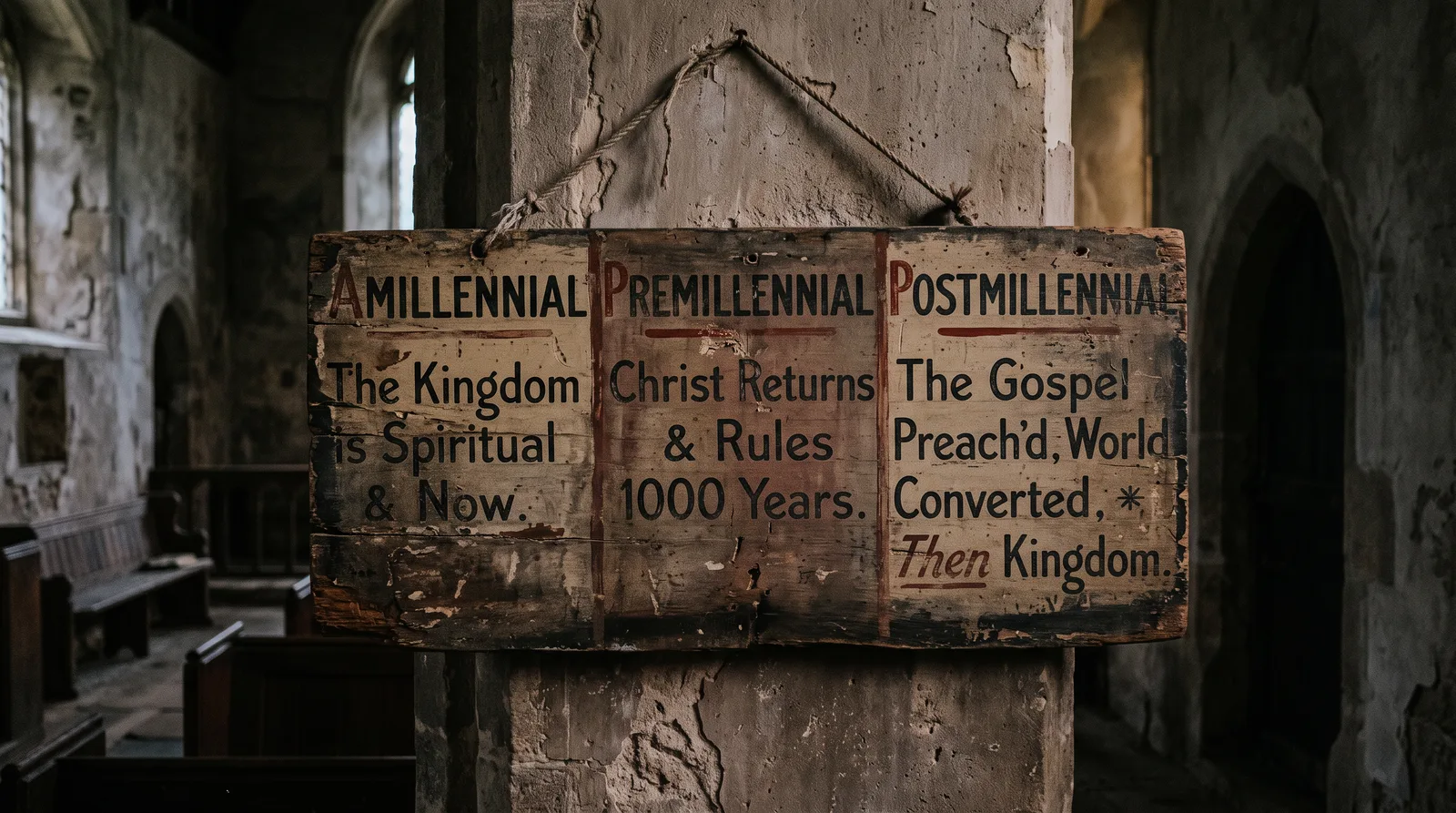
If you've spent any time in Christian circles, you've probably heard the words thrown around: the rapture, the tribulation, the thousand-year reign, the Second Coming. You may have heard people argue about them with surprising intensity — or felt quietly embarrassed that you couldn't follow the argument at all.
That confusion is completely normal. Eschatology — the theological study of last things — is genuinely complex, and the terminology gets tangled fast. So before you can have a meaningful opinion, you need a clear map of the territory.
The three main millennial positions all orbit around a single passage: Revelation 20:1–6, where John describes a "thousand years" during which Satan is bound and the saints reign with Christ. That's it — six verses. And yet the interpretation of those verses has produced three distinct theological frameworks, each with serious biblical arguments behind it.
Let me walk you through each one clearly.
Premillennialism: Christ Returns Before the Thousand Years
Premillennialists believe that Jesus Christ will physically return to earth before a literal thousand-year reign begins. In this view, history is currently heading toward a climactic crisis — often involving a period of intense tribulation — after which Christ personally intervenes, defeats evil, and establishes a visible, earthly kingdom centered in Jerusalem. Only after that millennium ends does the final resurrection and judgment occur.
Within premillennialism there are important subdivisions. Historic premillennialism — held by early church figures like Justin Martyr and Irenaeus — simply expects Christ to return before the millennium, with the church passing through tribulation first. Dispensational premillennialism is the more modern version (developed largely in the nineteenth century by John Nelson Darby and popularized in America through the Scofield Reference Bible and later the Left Behind series). It adds a distinct rapture event, a rebuilt temple, and a sharp separation between God's purposes for Israel and God's purposes for the Church.
When your neighbor talks about "the rapture," they're almost certainly drawing on dispensational premillennialism.
Postmillennialism: Christ Returns After the Thousand Years
Postmillennialists believe that the thousand years — whether literal or figurative — refers to a future golden age of Christian influence that precedes the Second Coming. In this view, the gospel will gradually transform the world so thoroughly that righteousness spreads across nations and cultures. Christ then returns after this era of kingdom expansion to consummate history.
This was a surprisingly dominant view among American Protestants in the nineteenth century, fueling a great deal of missionary activity and social reform. If you believe the world is fundamentally improvable by the spread of the gospel, and that Christ's return crowns a history already being redeemed, you're thinking postmillennially. Critics often note that two world wars made this optimism harder to sustain, though a robust postmillennialism continues to have careful defenders today.
Amillennialism: The Thousand Years Is Symbolic and Present
Amillennialism — the name literally means "no millennium," though "realized millennium" is more accurate — holds that the thousand years in Revelation 20 is not a future earthly period but a symbolic description of the present age between Christ's resurrection and His return. Satan has been "bound" in the sense that his power to deceive the nations has been decisively curtailed by the gospel (see Matthew 12:28–29). The saints "reigning with Christ" refers to the souls of believers in the intermediate state, or to the church's authority in this age, depending on the interpreter.
In this view, when Christ returns, everything happens at once: resurrection, final judgment, and the new creation. There is no intervening millennium. Augustine is the most influential early champion of this reading, and it remains the dominant view across much of Catholicism, Lutheranism, and Reformed theology.
What's Actually at Stake?
Here's where it matters. These aren't just abstract puzzles — each position carries real theological weight.
Your view of the Church and Israel. Does God maintain two distinct redemptive programs (one for ethnic Israel, one for the Church), or has Christ united them in one new humanity? Dispensational premillennialism answers one way; the other positions generally answer differently, and the difference shapes how you read large portions of the Old Testament.
Your view of history. Is history getting better (postmillennialism), getting worse until Christ intervenes (much premillennialism), or simply running its course until the appointed end (amillennialism)? That shapes your social engagement, your political imagination, and your pastoral comfort during hard times.
Your hermeneutics. How literally do you read apocalyptic literature? Revelation is apocalyptic — a specific ancient genre full of symbolic numbers, cosmic imagery, and coded language. Whether you treat "a thousand years" as a precise chronological claim or as a literary symbol reflecting wholeness and completeness is fundamentally a question about how to read the kind of text Revelation actually is.
The Honest Bottom Line
Christians who love the same Scripture and hold the same gospel have sat in all three of these positions. That should make you humble. None of the three views are heresy; they are serious, biblically engaged attempts to interpret difficult material faithfully.
What you should resist is two temptations: dismissing eschatology as unimportant, and treating your preferred millennial view as a test of orthodoxy. The creeds say Christ "will come again to judge the living and the dead." They do not specify the sequence.
If you want to go deeper — to trace these positions through biblical theology, church history, and the actual text of Revelation itself — that's exactly what my course Theoria: Eschatology is built for. We work through the biblical evidence carefully, engage the best arguments from every position, and arrive at confident, grounded hope rather than speculative anxiety.
The end of the story is already written. Understanding it well is worth your time.

Want to go deeper than a blog post?
Theoria: Eschatology
A rigorous, hope-centered study of Christian eschatology — from biblical prophecy and the return of Christ to resurrection, final judgment, and the renewal of all creation. Rooted in Scripture, shaped by the best of Christian theology, and designed to produce confident faith rather than fearful speculation.
Start learning — $39/mo