What Did Early Christians Actually Believe About Jesus? A Beginner's Guide
TTheoria · July 28, 2026 · 4 min read
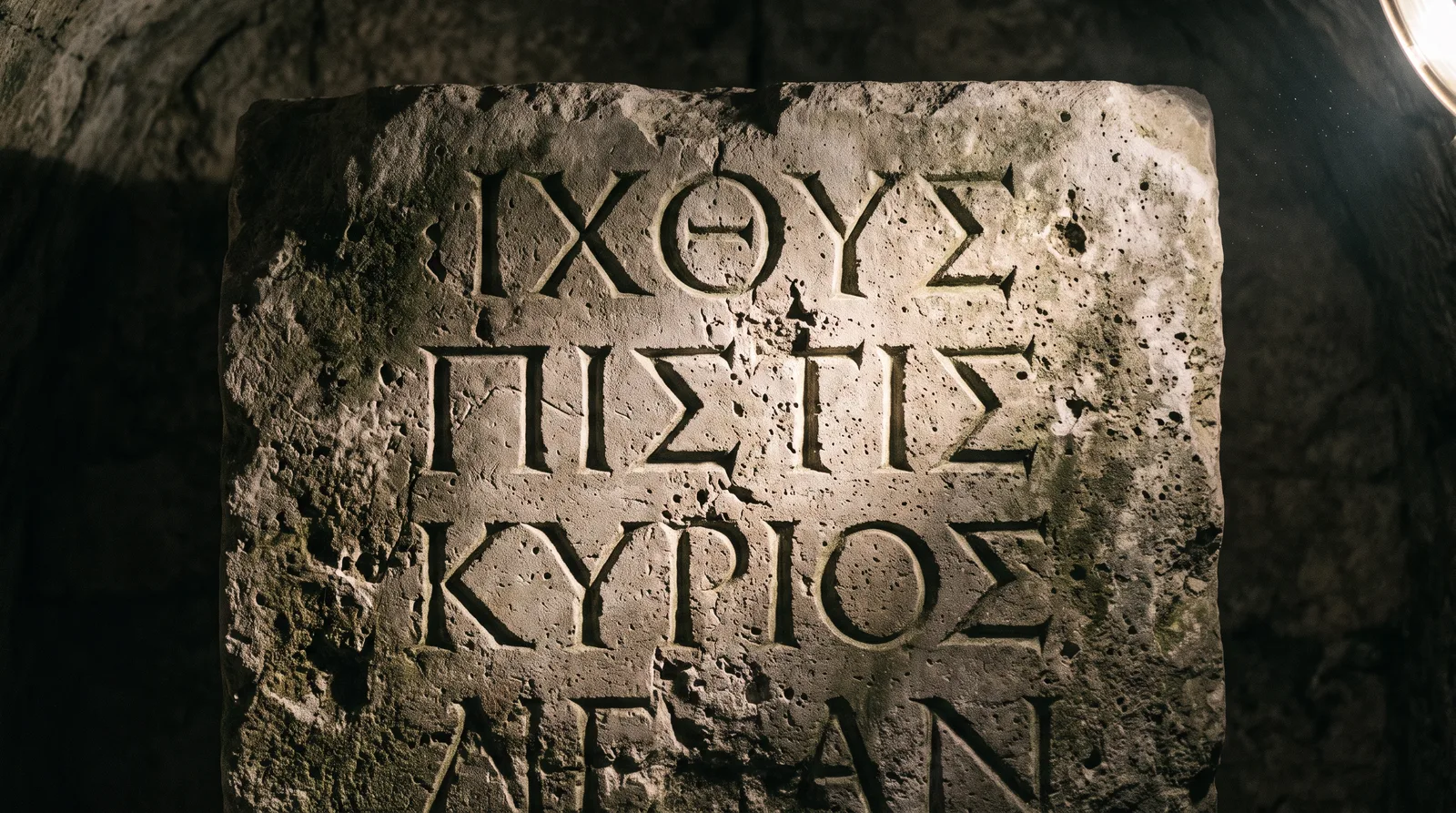
One of the most common claims you'll encounter in a casual conversation — or a college classroom — goes something like this: "The early Christians just thought Jesus was a good teacher. The Church made him God later, at the Council of Nicaea in 325 AD."
It's a confident-sounding claim. It's also historically wrong. And understanding why it's wrong is one of the most clarifying things a serious learner of Christianity can do.
Let's walk through what the earliest Christians actually believed about Jesus, where those beliefs came from, and what the first councils were really doing.
The New Testament Comes First
The Council of Nicaea met in 325 AD — but the letters of the Apostle Paul were written in the 50s AD, within twenty years of the crucifixion. That's not myth-building time. That's living-memory time.
And Paul is unambiguous. In Philippians 2, he quotes what most scholars recognize as an early Christian hymn — meaning it predates even the letter itself. That hymn describes Jesus as existing "in the form of God," taking on human flesh, dying, and being exalted so that "every knee should bow... and every tongue confess that Jesus Christ is Lord." The word Lord (Greek: Kyrios) was the same word Greek-speaking Jews used to translate the divine name YHWH in their scriptures. Paul's audience would have felt the weight of that.
In Colossians 1, Paul writes that in Jesus "all the fullness of God was pleased to dwell" and that he is "the image of the invisible God, the firstborn of all creation" — through whom all things were made. That is an extraordinary claim about a man who had been executed by Rome roughly two decades earlier.
John's Gospel, written later in the first century, opens with its famous prologue: "In the beginning was the Word, and the Word was with God, and the Word was God." John then says this eternal Word "became flesh and dwelt among us." Full divinity. Full humanity. Both, together, in Jesus of Nazareth.
The high view of Jesus is not a later imposition on the New Testament. It is the New Testament.
What the Early Church Fathers Said
Move past the apostles into the second century, and the pattern holds. Ignatius of Antioch, writing around 107 AD — early enough that he may have known the Apostle John personally — calls Jesus "our God." He writes to the Ephesians about "Jesus Christ our God" as naturally as you'd write a friend's name.
Justin Martyr in the mid-second century develops a sophisticated theology of Christ as the divine Logos — the rational principle through whom God made and governs the world, now made flesh.
Irenaeus of Lyon, writing around 180 AD, argues at length against various groups who wanted to separate Jesus's divinity from his humanity. His insistence? You can't do that. The whole point of salvation is that the one who saves us is genuinely God and genuinely human. He called this recapitulation — Christ re-heads humanity, living the human life we failed to live, and bringing us back to God.
None of these writers thought they were innovating. They thought they were explaining what the apostles had always taught.
So What Was Nicaea Actually Doing?
Here's the key distinction beginners need to grasp: the Council of Nicaea in 325 AD was not inventing a belief. It was defining and defending a belief that was already widespread — against a specific challenge.
A theologian named Arius argued that the Son of God was the first and greatest of God's creatures — exalted beyond all others, but still a creature. "There was a time when he was not," Arius taught.
The council's response, led by voices like Athanasius of Alexandria, was firm: No. The Son is not a creature. He is homoousios — of the same substance as the Father. Fully and truly God.
This wasn't a power play or a political invention. It was the Church drawing a line and saying: the faith we received from the apostles does not allow this revision.
Why This Matters for You
Understanding early Christology isn't just historical trivia. It changes how you read the New Testament, how you engage skeptics, and how you understand what Christians mean when they say Jesus is Lord.
The doctrine didn't drop from the sky in 325. It grew from the resurrection proclamation, through apostolic letters and hymns, through pastors and martyrs and bishops — and the councils named and protected what had always been believed.
If you want to go deeper into this — the biblical texts, the theological arguments, the councils themselves, and the figures who shaped orthodox Christology — that's exactly what Theoria: Christology is built for. We don't skip the hard questions. We work through them carefully, historically, and theologically.
The earliest Christians believed Jesus was fully God and fully human. The question worth asking is: why, and what does that mean? That's where the real study begins.

Want to go deeper than a blog post?
Theoria: Christology
A rigorous, scripture-anchored study of the person and work of Jesus Christ — from biblical witness to ecumenical councils — equipping serious learners to understand the doctrine at the very center of the Christian faith.
Start learning — $39/mo