
The PSLE English Writing Roadmap for P5 Students: Where to Start If You Feel Lost
Tuition on Demand Academy · July 26, 2026 · 4 min read
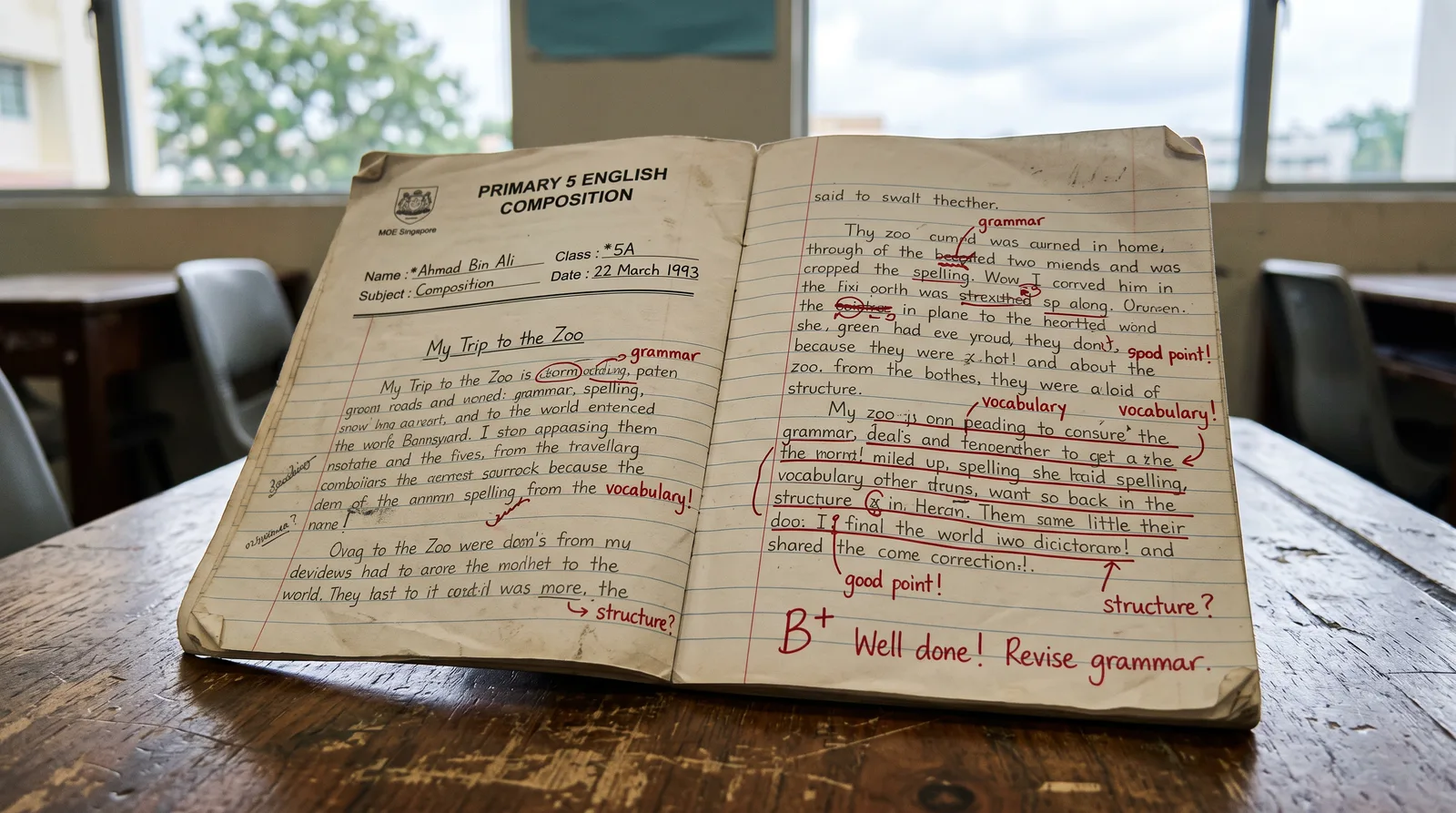
If composition writing feels like you're always starting from zero, you're not alone — and you're not behind. Most P5 students who struggle with writing aren't lacking ideas. They're missing a clear order of things to work on. This post gives you that order.
Work through these stages one at a time. Don't skip ahead. Each one builds the foundation the next stage needs.
Stage 1: Write Sentences You're Actually Proud Of
Before you can write a good paragraph, you need sentences that do more than just state facts.
A flat sentence: The boy ran.
A better sentence: The boy sprinted down the corridor, his schoolbag thumping against his back with every stride.
The upgrade isn't magic — it's three simple moves:
- Swap a weak verb for a precise one. Walked slowly → trudged. Said loudly → bellowed.
- Add a physical detail. What could someone see, hear, or feel in that moment?
- Use a participial phrase. His heart hammering, he reached for the door. These are examiners' favourites and they're not hard once you practise them.
Set yourself a daily drill: take one dull sentence and rewrite it using all three moves. Ten minutes a day on this alone will change how your writing feels within two weeks.
Stage 2: Build Paragraphs That Move
Good PSLE compositions are marked on Content and Language. Weak paragraphs hurt both.
A strong body paragraph does three things:
- Sets the scene or action (what is happening?)
- Shows a character's reaction (what does the character feel or do?)
- Pushes the story forward (what changes because of this moment?)
If your paragraph only does the first thing, it reads like a report. Practise writing short three-sentence paragraphs — one sentence per job — until the structure feels natural. Then expand each sentence into two or three. That's a publishable paragraph.
Stage 3: Learn the Three Story Shapes That Always Work
The PSLE picture-based composition gives you a set of images and expects a coherent story. You don't need a wildly original plot. You need a reliable story shape that fits most prompts.
Here are three worth memorising:
| Shape | Core idea |
|---|---|
| Mistake → Consequence → Lesson | A character does something wrong and faces a real outcome |
| Problem → Attempt → Resolution | A challenge arises, efforts are made, something is resolved |
| Ordinary moment → Unexpected turn → New understanding | A routine situation is interrupted by something surprising |
When you see the prompt pictures, ask yourself: which shape fits what I can see? Pick one and commit. A clear, well-executed simple plot outscores a complicated messy one every time.
Stage 4: Write a Beginning That Hooks and an Ending That Lands
Markers read hundreds of compositions. An opening that begins with One day, it was a sunny morning… blends into the pile.
Two opening moves that work:
- In medias res — drop into the middle of action. "Look out!" Maya screamed, but it was already too late.
- Sensory scene-setting — anchor the reader in one vivid physical detail. The smell of rain hit Ethan before the first drop did.
Two ending moves that work:
- Reflection — one line showing what the character now understands or feels differently about.
- Full circle — bring back an image or phrase from your opening so the story feels complete.
Your beginning and ending together take up maybe 10% of your word count and carry enormous marking weight. Give them deliberate attention.
Stage 5: Write One Full Practice Composition — Then Fix It
Everything above only becomes skill when you apply it to a complete piece. Write a full composition (aim for 350–400 words) using a past-paper prompt. Then review it against this checklist:
- Does every paragraph contain a character reaction, not just action?
- Did I use at least three precise verbs (no walked, said, went)?
- Is my opening something other than a weather or time statement?
- Does my ending connect back to the beginning or reflect a change?
- Are there any sentences I could join with a participial phrase?
Every "no" is a targeted revision task — not a failure, a to-do list.
The Honest Timeline
If you start Stage 1 now and spend 20–30 minutes on writing practice three times a week, you can realistically work through all five stages before the P6 year begins. That means you enter P6 with a repeatable process, not a hope.
The students who do well in PSLE Composition aren't necessarily the most creative — they're the most deliberate. They know their story shape before they pick up the pen. They fix their verbs before they submit. They've practised the ending as hard as the opening.
That kind of deliberate practice is exactly what we build inside PSLE English Ace at Tuition on Demand Academy — with scaffolded writing tasks, model answers, and AI feedback that shows you specifically what to fix, not just that something is wrong.
But start with the roadmap above. Seriously. It works.