
5 Mistakes English Learners Make on US Job Applications (And How to Fix Them)
PLParlioVox Learning · July 27, 2026 · 4 min read
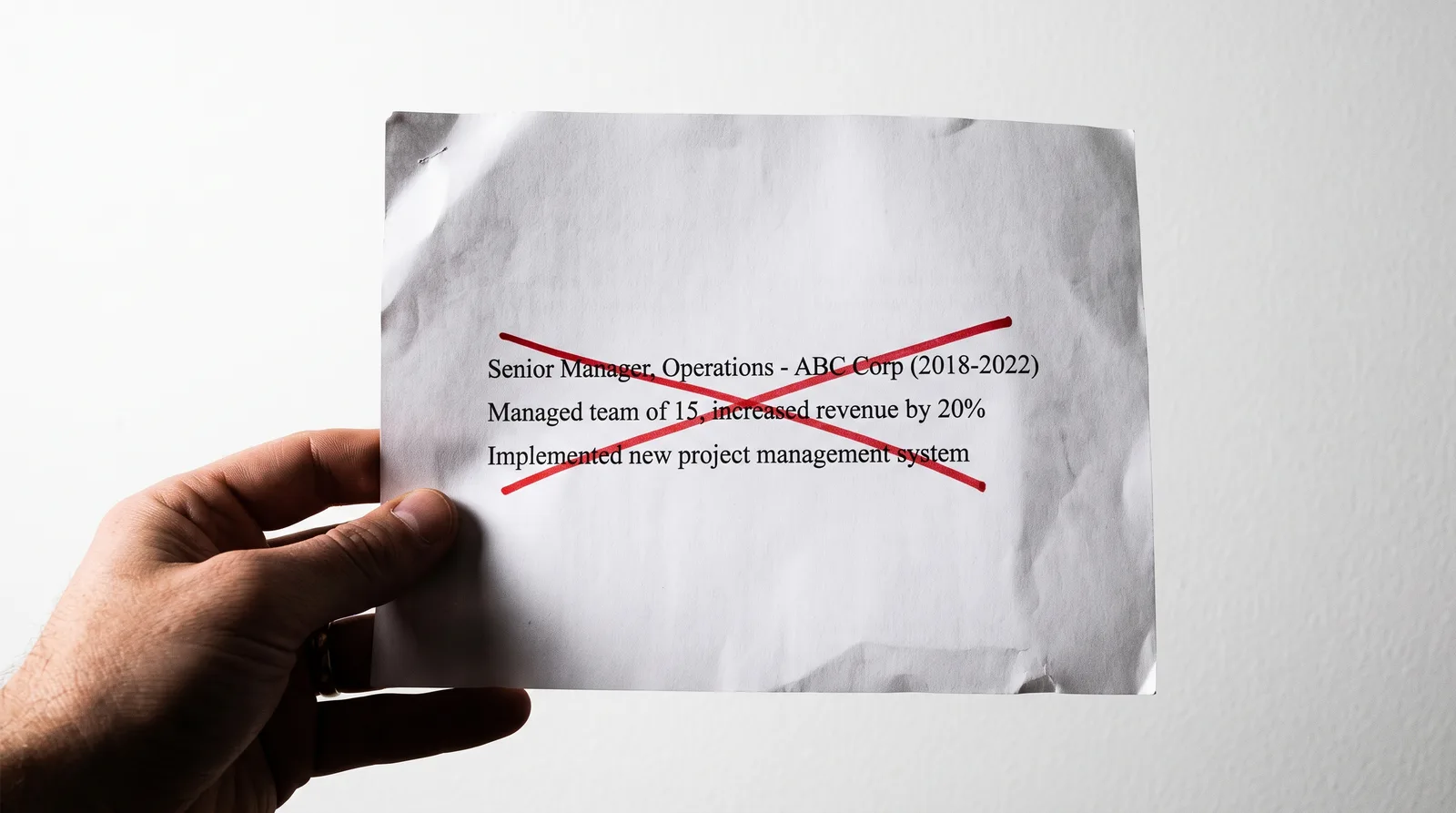
You spent hours on your resume. You ran it through a spell-checker. You asked a friend to look it over. And still, something feels off — or worse, you're not hearing back from employers and you don't know why.
Here's the hard truth: in the US job market, small language errors on application documents carry outsized weight. Hiring managers often review dozens of resumes in an hour. An awkward phrase or misused word can create an impression of carelessness before they've even read your experience. The good news? These errors are fixable, and fixing them is faster than you think.
Let's go through the five I see most often.
Mistake #1: Using "Responsible for" to Start Every Bullet Point
American resumes are written in a punchy, action-verb style. Starting every bullet with "Responsible for..." sounds passive and bureaucratic — and it buries the most important word (what you did) behind filler.
Instead, open every bullet with a strong past-tense action verb.
- ❌ Responsible for managing a team of five people.
- ✅ Led a five-person team to deliver projects on time and under budget.
Keep a list of power verbs handy: coordinated, developed, streamlined, implemented, collaborated, designed, trained, increased, reduced. Pick the one that most precisely describes your action.
Mistake #2: Translating Job Titles Word for Word
Every country has its own professional vocabulary. A direct translation of your title from Portuguese, Arabic, or Mandarin can confuse an American reader — or worse, accidentally undersell you.
If your translated title sounds awkward or unfamiliar, look up what US companies actually call that role on LinkedIn or Indeed, and use that equivalent in parentheses.
Example:
- ❌ Commercial Analyst of Products (translated literally)
- ✅ Product Analyst (equivalent title in US market)
You're not being dishonest — you're speaking the reader's professional language.
Mistake #3: Confusing "Experience in" vs. "Experience with"
This one trips up even advanced English learners, because the preposition rules don't map neatly onto other languages.
In American professional writing:
-
"Experience in" goes before a field, industry, or broad area → experience in marketing, experience in healthcare
-
"Experience with" goes before a tool, system, or specific skill → experience with Salesforce, experience with data visualization
-
❌ 5 years of experience with project management (project management is a field, not a tool)
-
✅ 5 years of experience in project management
-
❌ experience in Excel
-
✅ experience with Excel
It's a small shift, but it signals that you're fluent in professional register — which is exactly what a hiring manager wants to see.
Mistake #4: Writing a Cover Letter That's Just a Resume Summary
Many learners write cover letters that do nothing but repeat what's already on the resume: "I have three years of experience in sales. I am a hard worker. I am interested in this position." That tells the employer nothing they couldn't already read.
A US cover letter is meant to answer three questions:
- Why this company? (Show you've done research — mention something specific about their mission, product, or culture.)
- Why this role? (Connect your background to their exact needs.)
- What will you bring? (Give one concrete example of impact you've had.)
Keep it to three short paragraphs. The goal isn't to summarize your resume — it's to make a human case for why the conversation should happen.
Mistake #5: Using Formal, Old-Fashioned Phrases
Many learners were taught very formal English — the kind found in textbooks or translated from formal written styles in their home language. On a US job application, phrases like "Please find attached herewith my curriculum vitae" or "I humbly request your consideration" read as stiff and outdated.
American professional writing is direct and warm, not cold or overly formal.
| Instead of… | Try… |
|---|---|
| I humbly submit my application | I'm excited to apply for… |
| Please find my CV enclosed herewith | I've attached my resume for your review. |
| I await your favorable response | I'd love the chance to connect — please feel free to reach out. |
Confident and clear beats formal and flowery every time.
One Final Tip: Read It Out Loud
Before you send any application, read your resume and cover letter out loud. Your ear will catch what your eye misses. If a sentence feels hard to say, it's probably hard to read. Simplify it.
These fixes don't require a complete rewrite — they require precision. And precision is exactly what we work on in English for Success, where we go deep on the professional and academic English that actually gets people hired in the US, Canada, the UK, and beyond. If you're ready to take your application language from "good enough" to genuinely impressive, that's where we'll pick this up.

Want to go deeper than a blog post?
English for Success
Master the professional and academic English you need to land a job or gain university admission in Canada, the US, the UK, Ireland, or Australia. Real-world language skills taught by experts who know exactly what employers and admissions officers are looking for.
Start learning — $5/mo