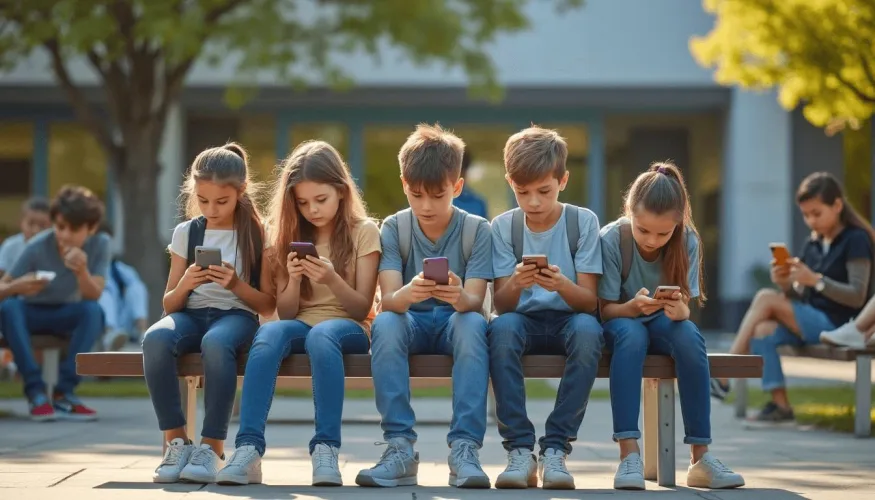
If you've ever heard "online school" and pictured a teenager slumped on a couch clicking through YouTube-style videos with zero interaction, you're not alone. That's the image most parents carry. And honestly? For a lot of online programs, it's not entirely wrong.
But AI-powered personalized learning is a fundamentally different animal — and the difference matters enormously for how much your child actually learns, retains, and applies. Let me break it down for you.
The Traditional Classroom Model (And Its Honest Limitations)
The traditional classroom was designed for efficiency at scale. One teacher, thirty students, one lesson plan, one pace. A skilled teacher does heroic work within those constraints — but constraints they remain.
Here's what that model structurally cannot do:
- Wait for a student who needs three more examples before a concept clicks, without slowing down everyone else
- Skip ahead for a student who mastered the material two weeks ago and is now quietly bored
- Revisit a gap from two grade levels back that is silently undermining everything new being taught
- Adjust the explanation style for a student who thinks visually versus one who thinks in sequences
None of this is the teacher's fault. It's a design problem. The classroom was built to deliver content to a group. Personalization was always a bonus, never the architecture.
What "Watching Videos Alone" Actually Gets Wrong
Basic self-paced online courses — the kind that launched in the early days of edtech — tried to solve the pacing problem by letting students move through pre-recorded lessons at their own speed. That was a genuine improvement. But it still delivered the same content to every student in the same order, and it had no real idea whether the student understood anything or just clicked "Next."
That's not personalization. That's a textbook you can pause.
What AI-Powered Personalized Learning Actually Does
Here's where the architecture changes completely. A well-built AI-powered learning system doesn't just deliver content — it continuously reads the student and responds. Practically speaking, that means several things are happening simultaneously.
Diagnostic mapping. Before a student ever opens a lesson, the system works to understand what they already know and where the real gaps are — not just "they're in 9th grade," but "they understand linear equations but have a shaky grasp of fractions that's about to become a problem in algebra." It works backward from the current grade level to find the foundational cracks.
Adaptive pacing. If a student breezes through three practice problems correctly, the system doesn't make them do fifteen more of the same thing. It advances. If a student struggles, it doesn't move on — it tries a different explanation, a different example, a different angle, until the concept lands.
Real-time feedback loops. In a classroom, a student might hand in an essay and wait a week to find out they completely misunderstood the prompt. In an AI-powered system, feedback is immediate and specific — not just "wrong," but here's what you missed and here's how to think about it differently.
Subject-specific scaffolding. A student working through AP Chemistry and also taking English doesn't need the same support structure in both subjects. The system tracks performance across subjects independently and adjusts difficulty, scaffolding, and review frequency for each one.
The Human Element Doesn't Disappear — It Gets Focused
This is worth saying plainly: personalized AI-powered learning doesn't replace human teaching. What it does is free human attention for the moments it matters most — genuine mentorship, motivation, nuanced discussion, the kind of guidance that requires wisdom, not just information delivery.
When a system is handling the drilling, the gap-filling, and the pacing logistics, a teacher or tutor can show up for the deeper conversations. That's a better use of everyone's time.
So What Should You Actually Look For?
If you're evaluating any personalized learning program — including ours — push past the marketing and ask these practical questions:
- Does it diagnose before it teaches? Or does it just start at lesson one and march forward?
- Does it adapt mid-lesson, or only between units? Real personalization is granular.
- Does it surface gaps across grade levels? A 10th grader with an 8th-grade math gap needs that gap addressed, not papered over.
- Is there a human in the loop? AI does the heavy lifting; a person should still be reachable.
- Does the student know why they're doing what they're doing? Transparency builds buy-in, especially for older students.
The goal of any learning system — traditional or AI-powered — should be the same: a student who genuinely understands, not one who just finished.
The difference is whether the system is built to reach that student, or just a student.
At Neo AI Tutor Academy, every course for grades 8–12 is built around exactly this kind of adaptive, diagnostic, personalized structure — across every required subject and AP course. If you want to see what that actually looks like for your student, we'd love to show you.