Current-State vs. Future-State Process Maps: What's the Difference and Which One Do You Need First?
TSThe Strategic Vault Academy · August 3, 2026 · 4 min read
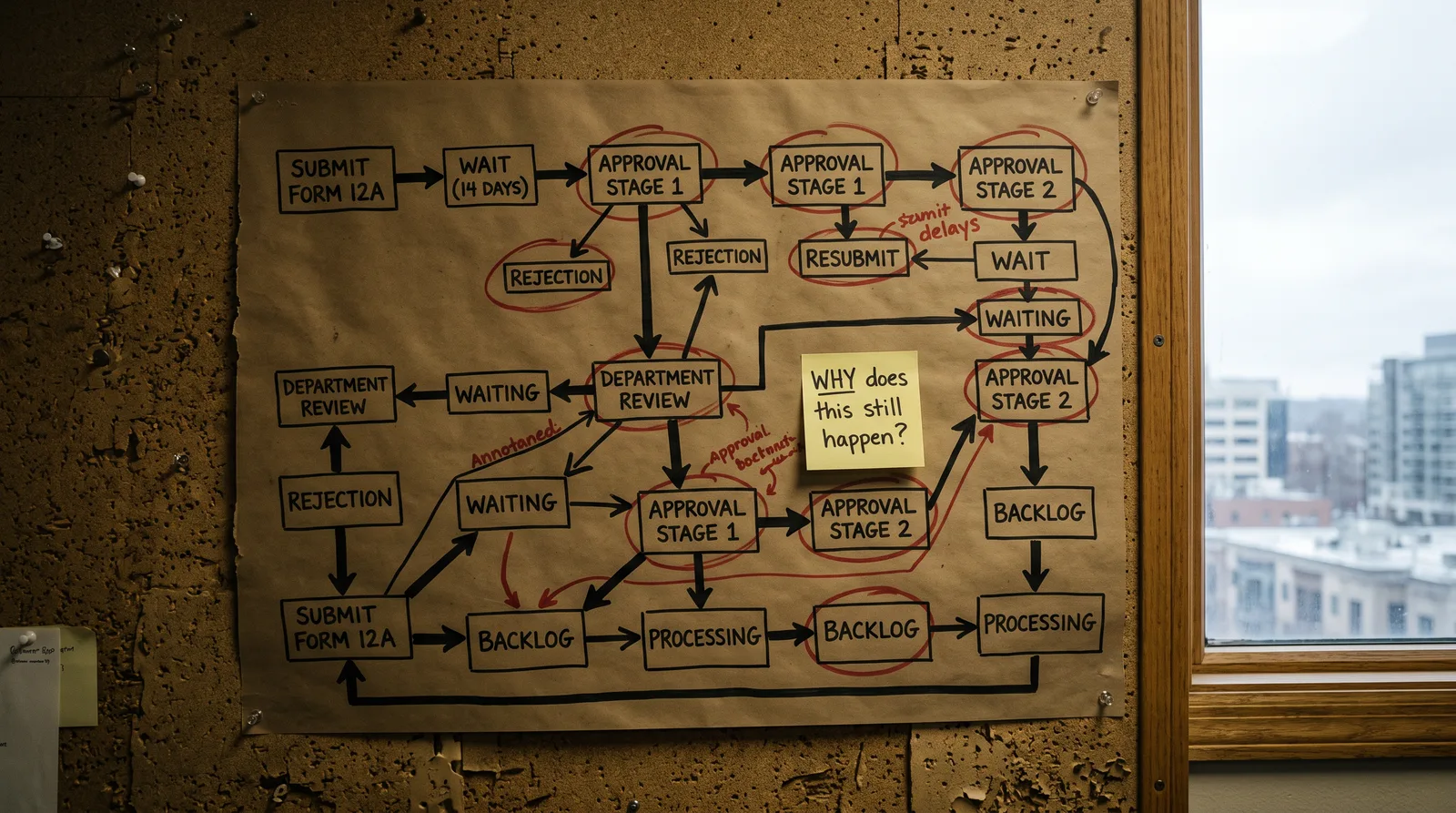
Every process improvement initiative I've seen stall out has one thing in common: the team jumped straight to drawing their dream version of how the work should flow, without ever pausing to document how it actually flows right now.
It feels productive. Visioning sessions are energizing. Future-state maps look impressive in a slide deck. But when the new process rolls out and the same bottlenecks reappear — just wearing different names — that's the cost of skipping the foundation.
Let's fix that.
What a Current-State Process Map Actually Is
A current-state map (sometimes called an "as-is" map) is a precise, visual documentation of how a process operates today — not how the policy manual says it should work, not how your most efficient team member does it, but how it actually, consistently happens across your unit.
That distinction matters enormously in the public sector. Government agencies almost always have a formal process on paper and a real process in practice. Those two things are rarely the same. Over time, workarounds accumulate. A system went down once and staff found a manual fix that never got retired. A supervisor added an extra approval step after a compliance scare three years ago and nobody removed it when the risk passed. These workarounds are invisible until you map them.
A solid current-state map captures:
- Every step in the process, in sequence
- Who performs each step (role, not individual name)
- Handoff points — where work moves from one person, team, or system to another
- Decision points — where the process branches depending on conditions
- Pain points and delays — ideally noted directly on the map where they occur
- Systems and tools used at each stage
The goal isn't a pretty diagram. The goal is an honest mirror.
What a Future-State Process Map Is
A future-state map (the "to-be" map) documents how the process will work after your improvements are implemented. It's aspirational — but it should be grounded, not wishful.
The best future-state maps don't reinvent everything. They identify the specific steps worth keeping, the handoffs worth streamlining, the decision points worth automating or eliminating, and the approvals that were never adding value in the first place. They reflect real constraints: your budget, your workforce, your technology, and your regulatory environment.
A future-state map that ignores those constraints isn't a plan. It's a vision board.
Why You Cannot Build a Credible Future State Without the Current State
Here's the practical truth: your future-state map is only as good as your understanding of what you're changing from.
Without a current-state map, you're guessing at where the real inefficiencies live. You might spend months redesigning a step that wasn't the actual problem. You might eliminate a handoff that exists for a compliance reason nobody thought to mention. You might propose a technology solution that duplicates a capability you already have in a system three departments over.
More critically, when you go to build your business case — to justify the investment of time, staff capacity, and potentially dollars — leadership will ask: What's broken, exactly? How do we know this redesign will fix it? A current-state map with documented pain points, cycle times, and rework loops is what lets you answer that question with evidence instead of anecdote.
The current-state map is your business case foundation.
Which One Do You Need First? (You Already Know the Answer)
Current state. Always.
Here's the sequence that actually works:
- Map the current state through direct observation and staff interviews — not just a conference room conversation with managers.
- Analyze the map to identify waste, delays, redundancies, and compliance risks.
- Define your improvement goals based on what the analysis reveals.
- Design the future state as a direct response to what you found — not a blank-canvas brainstorm.
- Build your action plan for moving from here to there, with clear owners and milestones.
Skipping step one and starting at step four is like prescribing medication before you've run any diagnostics. It might work. It probably won't. And you won't know why either way.
The Practical Place to Start
If you've never built a current-state map before, start smaller than you think you need to. Pick one process — a single intake workflow, one approval chain, one reporting cycle — and walk it from trigger to completion. Talk to the people who do the work every day, not just those who oversee it. Draw exactly what you find, including the parts that don't make sense.
Especially the parts that don't make sense. Those are where the gold is.
The current-state map won't be comfortable. It rarely is. But it will be honest — and in process improvement, honesty is the only starting point that leads somewhere real.
If you're ready to go deeper on process mapping, business case development, and turning your analysis into an executive-ready improvement plan, that's exactly what we build inside Process Intelligence. It's a rigorous, applied curriculum designed for public sector leaders who need more than frameworks — they need results.

Want to go deeper than a blog post?
The Strategic Vault: Mapping the Hidden Factory of Inefficiency
Learn to map work as it actually happens, expose hidden inefficiencies, and build an executive-ready business case for operational improvement — all in one rigorous, applied curriculum.
Start learning — $10 · 30 days access