What Is a Logic Model — and How Do Government Leaders Actually Use One?
TSThe Strategic Vault Academy · August 3, 2026 · 4 min read
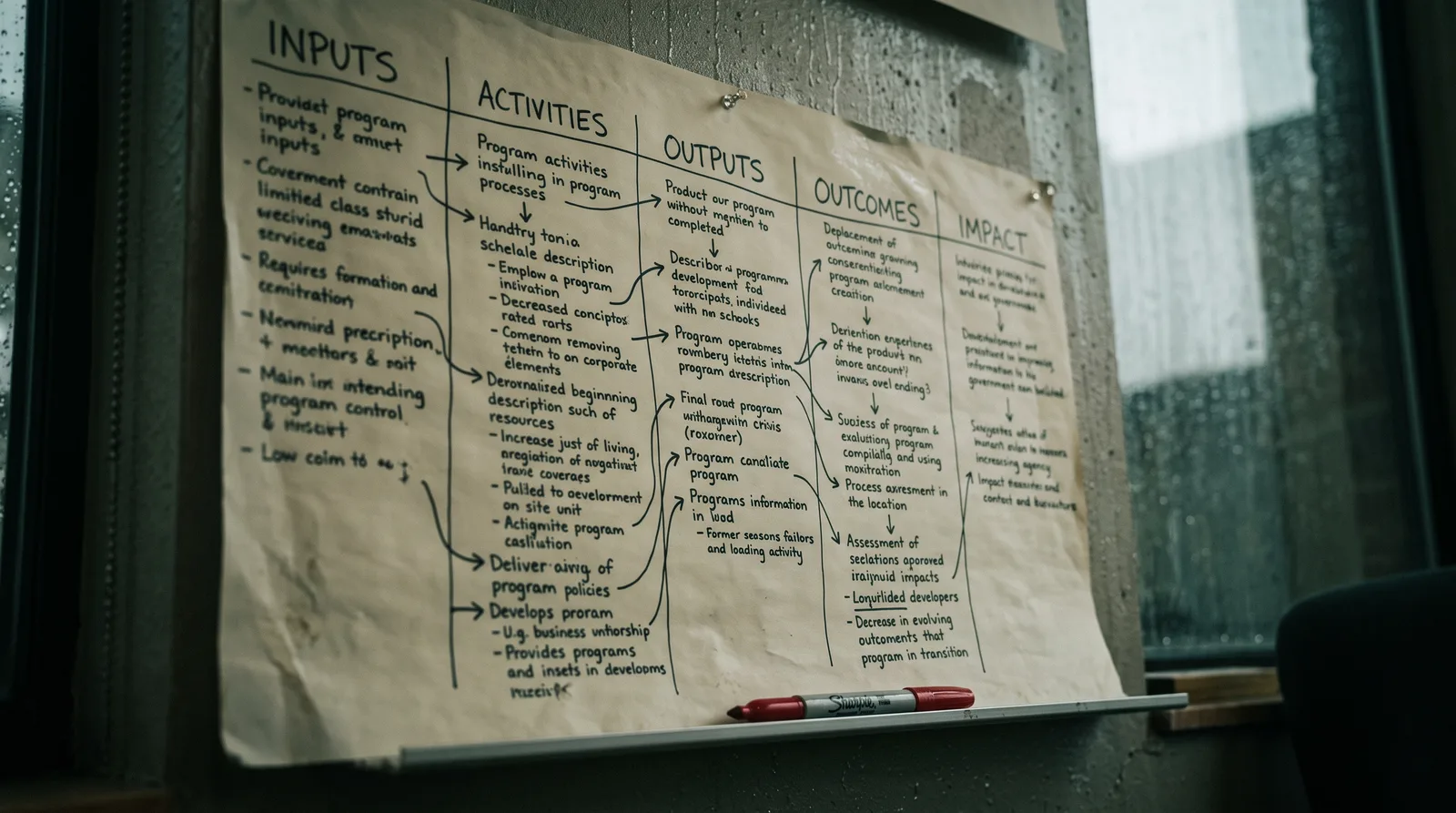
If you've sat through a federal grant review, a program evaluation briefing, or a performance improvement meeting and heard the words "logic model" — and then quietly nodded while having absolutely no idea what was being discussed — you are not alone. This tool shows up constantly in public sector planning, yet it rarely gets a proper introduction. Let's fix that right now.
What a Logic Model Actually Is
A logic model is a visual map that shows how a program is supposed to work. It connects the resources you put in, the activities you run, the things you produce, and the changes you're ultimately trying to make in the world. Think of it as a one-page theory of change — a structured argument that says, "If we do X, we believe Y will happen, which will lead to Z."
That's it. It's not a budget. It's not a project plan. It's a story about cause and effect, told in boxes and arrows.
The Five Core Components
Most logic models used in government settings follow a left-to-right flow with five components. Here's what each one means in plain language:
1. Inputs These are everything you invest to make the program run — funding, staff time, facilities, partner agreements, data systems, community relationships. If you removed it and the program would break, it's an input. For a federally funded workforce development program, inputs might include a Department of Labor grant, local agency staff, employer partnerships, and a case management platform.
2. Activities These are what your team actually does — the workshops you facilitate, the services you deliver, the assessments you conduct, the outreach campaigns you run. Activities are the engine of the program. They're where your staff spends their days.
3. Outputs Outputs are the direct, countable products of your activities. Number of training sessions held. Number of participants enrolled. Number of referrals made. Outputs are measurable and relatively easy to track — but here's the trap: a strong output number does not guarantee anything actually changed for the people you served.
4. Short-Term Outcomes Now we're asking: so what? Short-term outcomes are the changes in knowledge, skills, attitudes, or behavior that you expect to see in participants relatively soon after engaging with your program — typically within six to twelve months. For a workforce program, a short-term outcome might be that participants can write a targeted résumé or successfully complete a credentialing exam.
5. Long-Term Outcomes (and Impact) These are the bigger, slower changes your program is ultimately working toward — increased employment rates, reduced public assistance dependency, stronger local economies. Impact sits at this end of the model. You may not be able to claim full credit for it, but you should be able to draw a credible line from your inputs all the way here.
Why Government Leaders Underuse It
Logic models get dismissed for two reasons. First, they're often introduced as a compliance artifact — something you fill out for a grant application and never look at again. Second, they can feel abstract when they're built in a vacuum, disconnected from the messy reality of how programs actually operate.
Both of those are failures of use, not failures of the tool itself.
When a logic model is built collaboratively — with program managers, frontline staff, and stakeholders in the room — it becomes one of the most clarifying conversations a leadership team can have. Disagreements surface fast. You will quickly discover that your deputy director thinks the program's goal is X while your operations lead has been executing for Y. That tension is valuable. The model forces you to resolve it on paper before it costs you in practice.
How to Build Your First One
Start simple. Open a blank slide or a sheet of paper and draw five columns. Label them: Inputs → Activities → Outputs → Short-Term Outcomes → Long-Term Outcomes. Pick one program you're responsible for — just one — and fill in each column honestly.
As you work left to right, keep asking: If we do this, what does it produce? If we produce this, what changes? If you can't answer those questions, that's the gap your program strategy needs to address.
Once you have a draft, test it with your team. Ask them: Does this reflect how we actually work? Are there activities happening that don't connect to any outcome? Are there outcomes we're claiming that no activity actually drives? Those disconnects are your operational intelligence.
What This Unlocks
A logic model isn't just a planning document. It's the foundation for performance measurement, program evaluation, budget justification, and stakeholder communication. When a legislator asks why your program deserves continued funding, your logic model is the backbone of that answer. When an auditor asks how you know your program works, it's the roadmap.
Public sector leaders who can build, read, and defend a logic model are speaking the language of accountability — and that's a language that earns trust at every level of government.
If you want to go further — turning this foundation into a full performance framework, an executive-ready business case, or a 30/60/90-day implementation plan — that's exactly what we work through inside the Strategic Vault Academy and Process Intelligence programs. But for now, pull out that blank slide. One program. Five columns. Start there.

Want to go deeper than a blog post?
The Strategic Vault: Confronting the Invisible Barriers
Executive-grade, self-paced courses that transform complex strategic frameworks into interactive learning experiences — complete with real-world deliverables, decision tools, and implementation action plans.
Start learning — $10 · 30 days access