
PSLE English Paper 1 vs Paper 2: What's the Difference and How Should You Study for Each?
Tuition on Demand Academy · July 26, 2026 · 4 min read
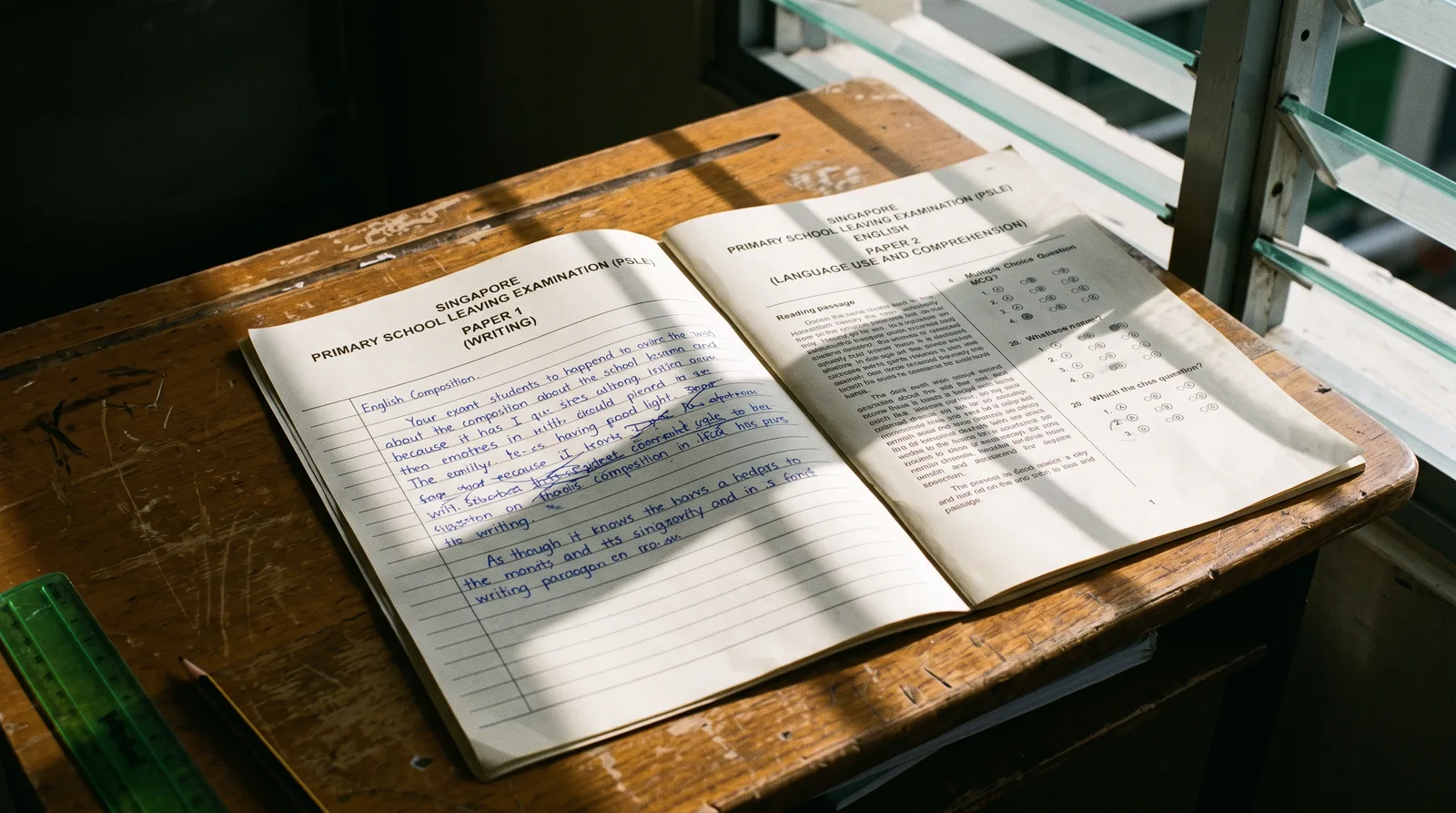
If your child sits down to "do English" without thinking about which paper they're practising, they're probably leaving marks on the table. Paper 1 and Paper 2 look like they belong to the same subject — and they do — but they demand very different things from a student's brain. Mixing up the preparation approach is one of the most common mistakes I see at this level, so let's fix that right now.
What Paper 1 Is Actually Testing
Paper 1 is your child's chance to be a writer. It has two components:
- Situational Writing (Section A): Students respond to a writing situation — a letter, an email, a notice, a report — and must address a specific purpose, audience, and format. Marks are awarded for content and language.
- Continuous Writing (Section B): Students choose from picture prompts or a theme and write a composition of around 150–200 words minimum, though stronger pieces tend to run longer. This is where voice, ideas, and narrative craft come in.
The skill being tested here is production — your child creates language from scratch. There is no passage to read and draw answers from. The examiner is looking at whether your child can organise ideas logically, use vocabulary deliberately, and control grammar well enough that it doesn't get in the way of meaning.
What Paper 2 Is Actually Testing
Paper 2 is your child's chance to be a reader and analyst. It covers:
- Booklet A: MCQ comprehension and language components including grammar MCQ, vocabulary MCQ, and visual text comprehension
- Booklet B: Open-ended comprehension, synthesis and transformation (S&T), and editing
The skill being tested here is reception and manipulation — your child reads text that already exists and has to demonstrate they understand it, can identify how language works, and can rewrite sentences without changing their meaning. In S&T alone, a student needs to handle reported speech, passive and active voice, sentence combination, and more — each with its own grammatical rules.
Why the Same Study Method Doesn't Work for Both
Here's the trap: many students spend their English study time reading model compositions. That helps with Paper 1. But it does almost nothing for S&T, grammar MCQ, or open-ended comprehension — which together make up a significant chunk of Paper 2 marks.
Equally, drilling S&T patterns obsessively builds accuracy and rule-recall — but it won't help a student who freezes in front of a blank composition prompt.
The two papers need two different modes of thinking, and your preparation should reflect that.
A Targeted Approach for Paper 1
1. Build a writing process, not just a writing habit. Before your child writes a single word of a composition, they should spend time planning: What is the conflict or situation? What emotion should the reader feel by the end? What is one specific, vivid detail they can include? Planning for five minutes consistently produces better compositions than diving straight in.
2. For Situational Writing, memorise the format conventions. Every format — formal letter, informal email, report — has non-negotiable features that carry content marks. Know the sender/recipient layout for letters, know that a report needs a clear heading and purpose statement, know what "register" means and practise shifting between formal and informal. These are marks your child should never lose.
3. Widen the vocabulary bank topic by topic. Keep a running list of strong verbs, precise adjectives, and topic-specific phrases grouped by theme — nature, family, school, competition. Revisit and use them, not just read them.
A Targeted Approach for Paper 2
1. Treat S&T as a rule system, not a guessing game. Every transformation type has a pattern. Take reported speech: tense shifts back, pronouns change, time expressions adjust. Drill one type at a time until the rule is automatic before moving to the next. Don't mix types in practice until each one is solid on its own.
2. For open-ended comprehension, answer in full and quote precisely. Partial answers lose marks. Train your child to identify the question word (how, why, what), find the relevant paragraph, quote the key phrase, and explain what it shows. That three-step habit is repeatable across any passage.
3. For editing, read aloud in your head. Errors in the editing section are often things that sound wrong when spoken. Encourage your child to sub-vocalise each sentence and ask: does this feel right? Does the subject and verb agree? Is the tense consistent? The ear catches a lot that the eye skips.
The Bigger Picture
Paper 1 rewards creativity and control. Paper 2 rewards accuracy and analytical thinking. Both reward consistent, deliberate practice — but different kinds of practice. Once your child understands which skills belong to which paper, they can walk into the exam knowing exactly what's expected of them and exactly how to deliver it.
That clarity alone changes how they sit down to study — and how confident they feel on exam day.