

Pricing is two decisions, not one: how much, and how often. Most first-time teachers agonize over the first and never consider the second — which is backwards, because the billing rhythm usually moves total revenue more than the sticker price does. Here's every option and when each one wins.
The four ways to charge
| Option | Student pays | Access | Built for |
|---|---|---|---|
| One-time | Once | A 30-day window | Workshops, sprints, challenges |
| Monthly | Every month | While subscribed | Ongoing practice: music, fitness, language |
| Every 6 months | Twice a year | While subscribed | Committed learners; fewer renewal moments |
| Yearly | Once a year | While subscribed | Serious commitments; best effective rate |

Which rhythm fits which teaching
One-time: the container with a deadline
Best when the value is a transformation with an endpoint: prep for a specific exam, a 21-day challenge, planning one event. The deadline is a feature — students who know the door closes actually do the work. Repeat buyers just purchase a fresh window.
Monthly: the default for skills
If your topic is practiced rather than completed — instruments, fitness, languages, crafts, trading — monthly matches how learning actually happens, keeps the entry price low, and compounds: the revenue table shows the same 10 students paying every month, not once. Most schools should start here.
Every 6 months and yearly: fewer chances to quit
Longer cycles trade a bigger upfront ask for fewer renewal decisions — every renewal is a moment a student can lapse, and a 6-month or yearly cycle has 2 or 1 of those per year instead of 12. They also suit topics with long arcs (certifications, degree-length skills). A common ladder: launch monthly, add a discounted 6-month or yearly option once students love it.
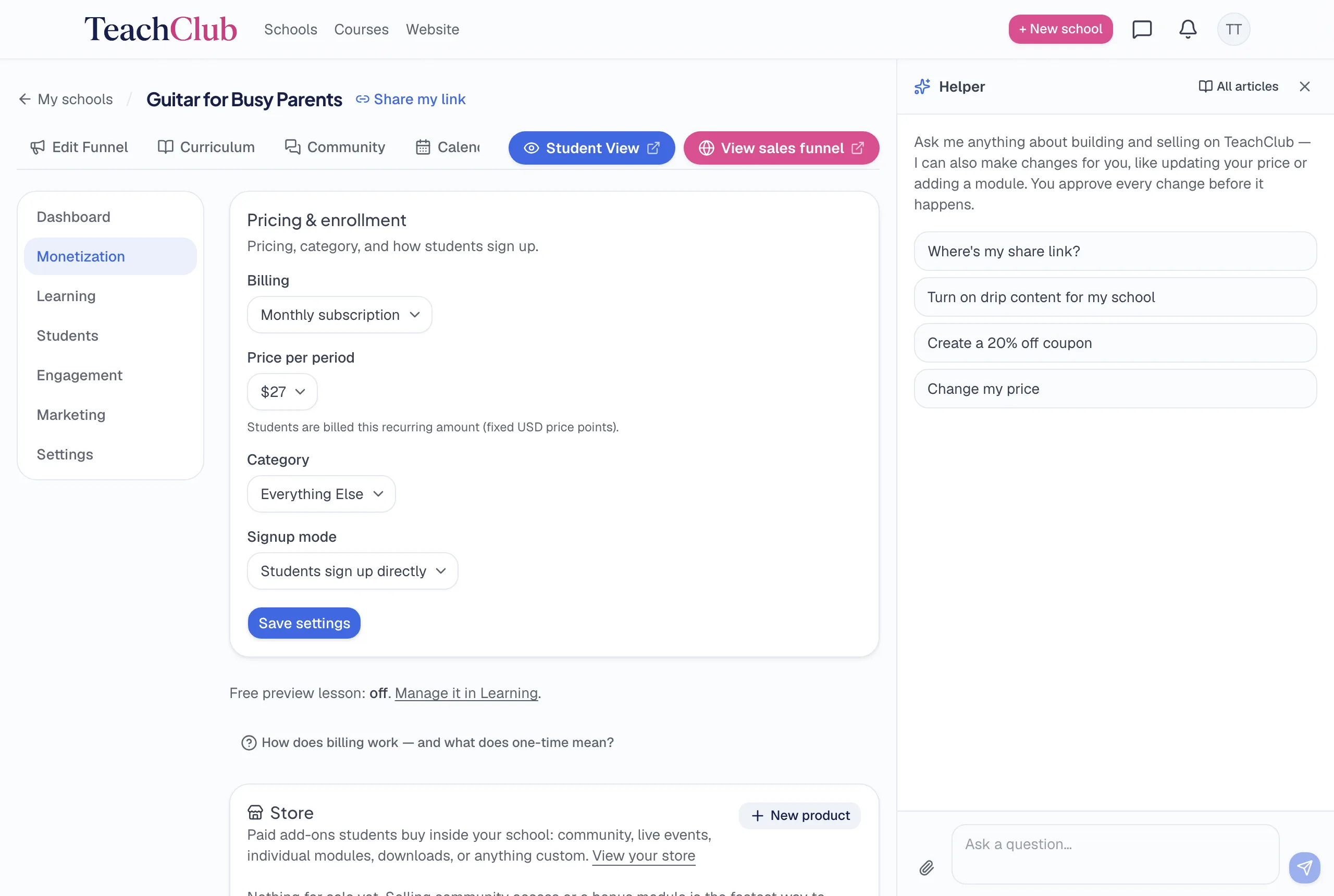
Changing your price later
Prices aren't tattoos. Change yours anytime — from settings or by telling the assistant — and the change applies to new students only; existing students keep the price they joined at. That grandfathering matters strategically: it makes "the price goes up next month" an honest urgency lever, and it means raising prices as your school proves itself never punishes your first believers.
The extras that move revenue
- Coupons (every paid plan): percent or dollar off, one code per campaign or per partner. A launch coupon is the classic first move — it gives your warm circle a reason to act now. Redemption counts show you what worked.
- Free preview lessons: open a lesson or two as a lead magnet so strangers can taste the teaching before paying — the strongest sales asset a school has.
- Order bumps and upsells (Club): an add-on at checkout, or a follow-on offer after purchase — the "would you like the workbook with that" of your school.
- Courses (Club): bundle multiple schools into one journey sold at one price — beginner school unlocks intermediate unlocks advanced.
And the road outside the checkout entirely
One more option completes the picture: you can sell access outside TeachClub — your own funnel, a premium package, any price you can command — and simply enroll your buyers into the school by email. That route uses a flat per-seat fee instead of the checkout's revenue split; the mechanics and math live in the migration guide. Most teachers never need it, but knowing the ceiling isn't capped by the checkout is worth a paragraph.
A sane way to decide today
- Practiced skill? Start monthly, at a price you'd defend out loud ($19–47/mo is where most first schools land).
- Transformation with an endpoint? One-time, named honestly ("the 30-day X"), priced like the outcome matters.
- Not sure? Monthly. It's the easiest to change away from, and your early students keep their deal either way.
Pick, publish, and let real students correct you — a price you can adjust next month beats a price you agonized over for three.