
AFCI vs. GFCI Breakers: What's the Difference and When Do You Need Each?
TMTodd McFarland · July 31, 2026 · 4 min read
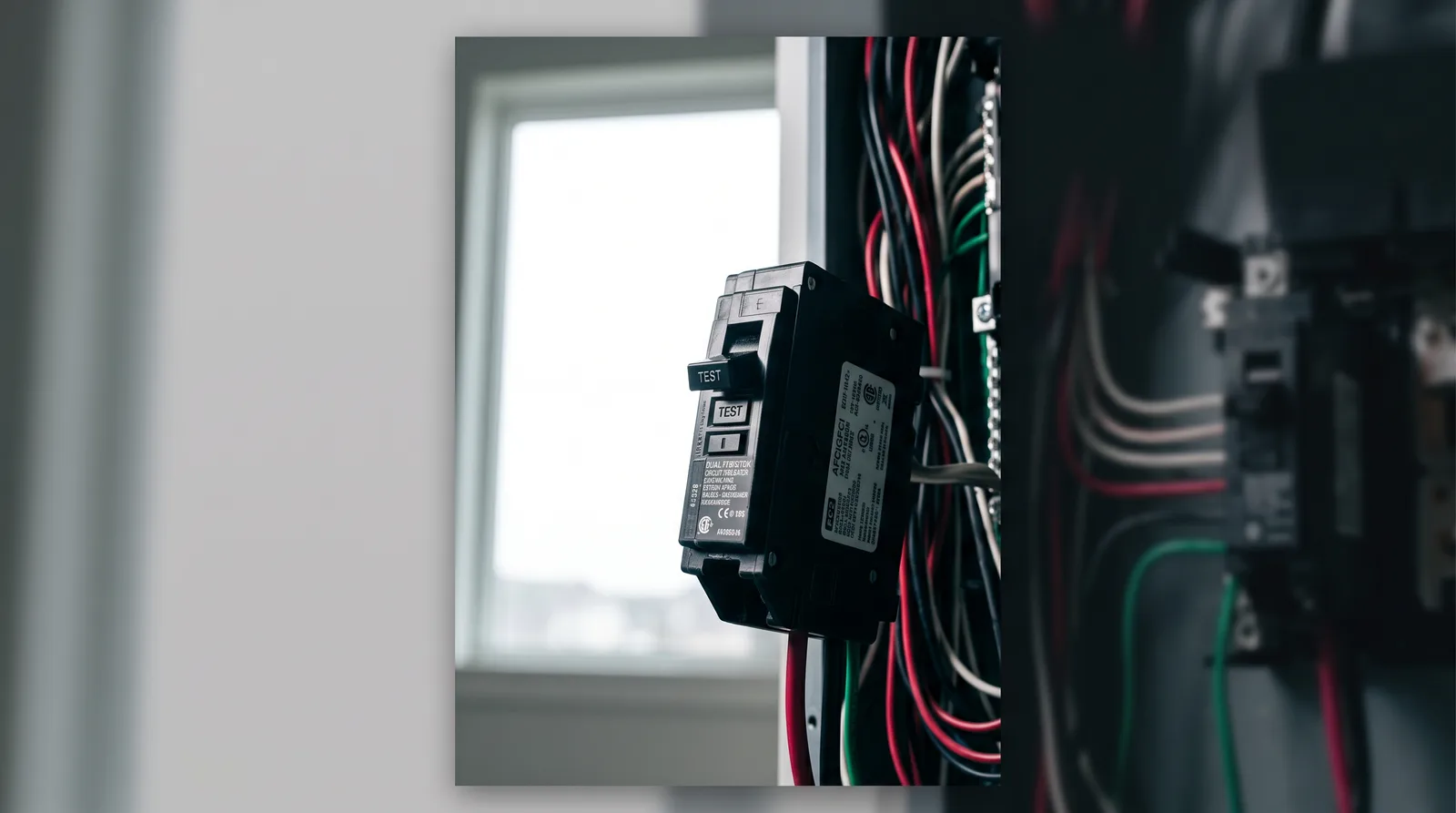
If you've ever stared at a panel schedule and second-guessed whether a bedroom circuit needs AFCI, GFCI, or both, you're not alone. These two breaker types sound similar, get confused constantly, and carry real code consequences if you get them wrong. Let me break it down so it actually sticks.
They Protect Against Two Completely Different Hazards
This is the core thing to understand, and once you get it, the code requirements start to make intuitive sense.
GFCI — Ground Fault Circuit Interrupter — protects people from electrocution. It monitors the difference in current between the hot and neutral conductors. The moment that difference hits about 5 milliamps — meaning current is finding a path to ground through something it shouldn't, like a person — it trips in as little as 1/40th of a second. That's fast enough to prevent cardiac arrest.
AFCI — Arc Fault Circuit Interrupter — protects property from electrical fires. It monitors the circuit for the signature waveform of an arc fault: the kind of intermittent, high-energy sparking that happens inside a damaged cord, a staple that's nicked a wire over the years, or a loose terminal in a device. A standard breaker won't trip on that because the current draw isn't high enough. An AFCI will, because it's reading the shape of the current, not just the magnitude.
Different hazard. Different technology. Different places in the home.
Where the NEC Requires GFCI
The National Electrical Code (NEC) has required GFCI protection in wet and damp locations for decades, and the list has expanded with every code cycle. Under the current NEC, GFCI protection is required for receptacles in:
- Bathrooms — all receptacles, no exceptions
- Garages and accessory buildings — including detached garages
- Outdoors — any receptacle with direct grade-level access
- Crawl spaces — at or below grade level
- Unfinished basements
- Kitchen countertop surfaces — receptacles within 6 feet of a sink
- Boathouses
- Bathtub and shower areas — even if there's no sink nearby
- Laundry areas, utility sinks, and wet bar sinks — within 6 feet of the sink edge
- Pool, spa, and hot tub equipment
The logic is consistent: anywhere water and electricity could plausibly meet, GFCI is there to protect the person who becomes the path.
Where the NEC Requires AFCI
AFCI requirements have grown steadily since they were first introduced in the 1999 NEC for bedroom circuits. The current NEC requires AFCI protection for all 120-volt, 15- and 20-amp branch circuits supplying outlets and devices in:
- Bedrooms — the original requirement, still here
- Living rooms, parlors, libraries, dens, sunrooms, recreation rooms, closets, hallways, laundry areas
- Kitchens
- Dining rooms and family rooms
In practice, that covers virtually every habitable room and the circuits feeding them. If a room has people in it, assume AFCI is required. The reasoning: those are the spaces with furniture, finished walls, and years' worth of cords running under rugs and behind baseboards — exactly where arc faults develop.
The Rooms That Need Both
Here's where a lot of people get tripped up on inspections: some locations fall under both requirements simultaneously. Kitchens and laundry areas are the most common examples. A kitchen countertop receptacle needs GFCI protection because it's within 6 feet of a sink — and it needs AFCI protection because it's in a kitchen circuit.
For these situations, you have a clean solution: dual-function AFCI/GFCI breakers. A single breaker handles both requirements, satisfies both code sections, and simplifies your panel labeling. They cost more than a standard breaker, but they're far less hassle than trying to coordinate a GFCI breaker with downstream AFCI devices.
A Practical Rule of Thumb for the Field
When you're roughing in or troubleshooting, run through these two questions for every circuit:
- Does this circuit serve a wet or damp location? → GFCI required.
- Does this circuit serve a habitable room or its outlets? → AFCI required.
If both answers are yes, reach for the dual-function breaker. If you're ever unsure which NEC edition your jurisdiction has adopted — and many jurisdictions run one or two cycles behind — check with your local building department before the rough-in inspection. That one phone call can save you a failed inspection and a re-inspection fee.
Getting these two breaker types straight is one of those fundamentals that separates someone who's read about electrical work from someone who can actually wire a house and walk away from the inspection with a green tag. In my course, we go through panel layouts, code lookups, and inspection prep in detail — so you're not guessing on job day.

Want to go deeper than a blog post?
Master Electrical
Learn the practical electrical skills that professionals use every day — from safely wiring outlets and panels to reading blueprints and passing inspections. No prior experience required.
Start learning — $49/mo