5 Common Mistakes Students Make on IGCSE Physics Exam Papers (And How to Fix Them)
The Chem Examiner Academy · August 13, 2026 · 4 min read
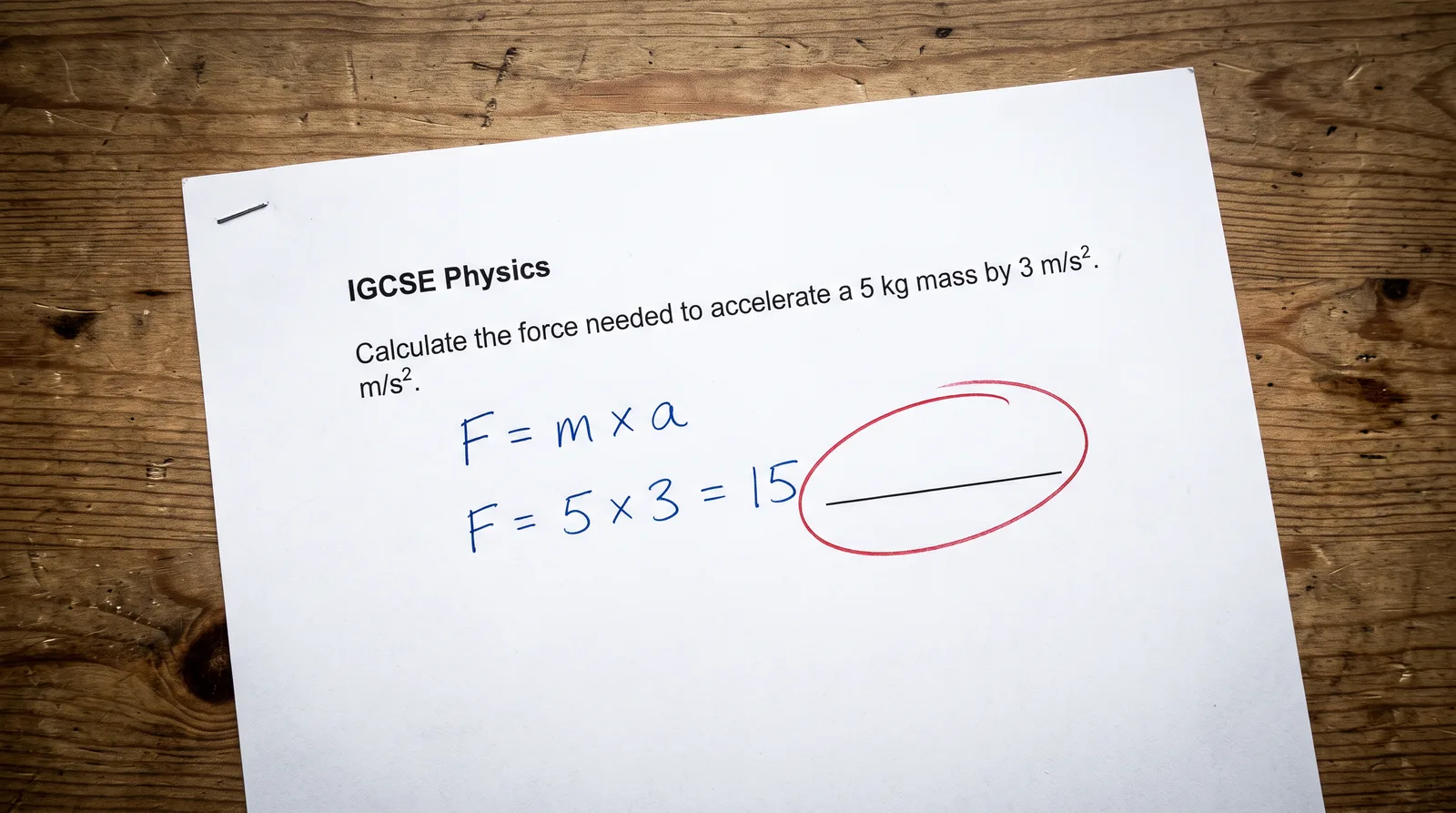
Every exam season, the same errors appear — not because students don't know the Physics, but because they haven't learned to write for a mark scheme. The examiner isn't reading your paper to understand what you meant. They're scanning for specific words, correct units, and precise reasoning. Once you understand that, fixing these five mistakes becomes straightforward.
1. Missing or Wrong Units
This is the single most reliable way to drop marks you've already earned. You do the calculation perfectly, get the right number, and then write nothing after it — or worse, write the wrong unit entirely.
The mark scheme almost always awards a separate mark for the unit. No unit, no mark.
The fix: Build a habit of writing the unit before you start calculating. Identify what you're solving for — speed, resistance, pressure — write the unit in your working space first, then fill in the number. Common ones to drill: velocity in m/s, force in N, energy in J, pressure in Pa, charge in C. When converting, be deliberate: 5 cm = 0.05 m, not 0.5 m.
2. Vague Explanations That Don't Match the Mark Scheme
"The temperature increases because the particles move faster." That sentence feels complete, but it often earns zero marks because it skips the causal chain the examiner is looking for.
IGCSE Physics explanations need to be mechanistic — each step linked to the next with precise language. The mark scheme rewards specific trigger words: kinetic energy, internal energy, resultant force, rate of change of momentum. General words like "energy goes up" or "it gets bigger" are almost never enough.
The fix: Practice the phrase "because… which means… therefore…" as a structure for any explain or describe question. For example: "The resistance increases because the temperature of the wire increases, which means the ions in the lattice vibrate with greater amplitude, therefore electrons collide with them more frequently and lose more energy per unit length." That's a mark-scheme answer. Count the links in the chain — if you only have one, you probably haven't gone far enough.
3. Misreading Graph Scales
Graph questions are generous with marks — and students give them away. The most common error is reading a scale that doesn't go up in ones. A y-axis marked 0, 20, 40, 60 with ten grid squares between each label means each small square = 2 units, not 1. Reading it as 1 throws every gradient, every intercept, and every value off.
The fix: Before you touch a graph question, spend fifteen seconds on the axes only. Write the scale increment for each axis in the margin: "each small square = 2 m/s." Do this before reading the question. When drawing a best-fit line, use a transparent ruler, position it so roughly equal numbers of points fall on each side, and don't force it through the origin unless the question explicitly tells you to.
4. Confusing "Describe" with "Explain"
These two command words are not interchangeable, and the mark scheme treats them completely differently. Describe means tell me what happens — the pattern, the trend, the observation. Explain means tell me why it happens — the Physics behind it.
If a question says "Describe the motion of the object between 0 s and 4 s," writing about forces earns you nothing. If it says "Explain why the acceleration decreases," describing the shape of the graph earns you nothing.
The fix: Circle the command word the moment you read any question. It takes two seconds and changes your entire answer. For describe questions, use comparative language: "As X increases, Y decreases at a decreasing rate." For explain questions, always reference a Physics principle or law by name.
5. Not Showing Working in Calculation Questions
A student who gets the final answer wrong but shows a correct method can still pick up marks. A student who writes only a wrong number picks up nothing. This is one of the most painful ways to lose marks because the Physics knowledge was there — it just wasn't visible to the examiner.
The fix: Write every step. Start with the formula. Substitute values with units. Rearrange if needed. Then calculate. Even if your arithmetic fails you at the last step, the examiner can award marks for the correct equation and correct substitution. On a 3-mark calculation, that could mean the difference between 0 and 2.
These five errors are correctable — not through more content revision, but through deliberate practice with past papers and active attention to how you're writing your answers. The Physics curriculum is the same for every student sitting that paper. What separates the grade boundaries is exam technique.
If you want to go deeper on any of these — particularly how to decode mark schemes across different question types — that's exactly what I work through with students in my courses. The mark scheme is a document with a logic to it, and once you see that logic clearly, every paper becomes more predictable.