IGCSE vs. GCSE Chemistry: What's Actually Different and Which One Are You Studying?
The Chem Examiner Academy · August 13, 2026 · 4 min read
If I had a dollar for every time a student came to me having revised the wrong content — preparing GCSE-style answers for an IGCSE paper, or vice versa — I'd have enough for a very decent chemistry textbook collection. It happens constantly, and it's nobody's fault. The names are genuinely confusing, schools don't always make it clear, and a quick Google search tends to blur the two together.
So let's fix that right now. By the end of this post, you'll know exactly which qualification you're sitting, what structurally separates them, and what that means for how you should be studying.
First, What Do the Letters Actually Mean?
GCSE stands for General Certificate of Secondary Education. It's the standard qualification taken by students in England, Wales, and Northern Ireland, typically at age 15–16.
IGCSE stands for International General Certificate of Secondary Education. It was originally designed for students studying in international schools outside the UK, but it's now also offered in many UK independent schools. The "I" signals an international scope — the syllabus is built to work across different national contexts.
The most common IGCSE Chemistry syllabuses are from Cambridge Assessment International Education (CAIE) and Pearson Edexcel International. The most common GCSE Chemistry syllabuses are from AQA, OCR, and Pearson Edexcel (note: Edexcel runs separate GCSE and IGCSE versions).
That last point trips people up constantly. Edexcel GCSE Chemistry ≠ Edexcel International GCSE (IGCSE) Chemistry. Same brand, different qualification, different papers.
The Key Structural Differences
1. Assessment Structure
GCSE Chemistry in England now includes required practicals — specific experiments you carry out in school that can be directly tested in your written papers. Examiners expect you to have done these practicals and will ask questions that assume hands-on familiarity with them.
IGCSE Chemistry typically has no compulsory school-based practical component baked into the written exam in the same way. Cambridge IGCSE does offer a practical paper or alternative-to-practical paper as part of the assessment, but the approach is different — you're often being tested on your understanding of practical techniques rather than a fixed list of required experiments.
This matters because GCSE students need to know their specific required practical methods cold. IGCSE students need a broader, flexible understanding of practical skills.
2. Tiering
Both qualifications use a tiered system, but the grade boundaries differ. GCSE uses Foundation (grades 1–5) and Higher (grades 4–9) tiers. Cambridge IGCSE uses Core (grades C–G) and Extended (grades A–E)* tiers. The Extended tier is the one most students aiming for strong grades will sit.
If you're targeting top grades, make sure you're entered for the right tier — and that you know which paper numbers correspond to your tier.
3. Content Overlaps and Differences
The core chemistry is largely the same — atomic structure, bonding, the periodic table, rates of reaction, electrolysis, organic chemistry. These are universal.
But the depth and framing differ. Cambridge IGCSE, for example, tends to be very precise in its command words — "state," "explain," "deduce" each mean something specific to the mark scheme. AQA GCSE has its own mark scheme logic. Knowing your exam board's language is not optional — it's half the battle.
Some content also appears in one but not the other. Cambridge IGCSE Chemistry includes topics like the industrial production of chemicals (Haber process, Contact process) with a particular framing. AQA GCSE has specific required content on quantitative chemistry that's examined in a particular way. Always check your specific syllabus document, not just a generic revision guide.
How to Find Out Exactly Which One You're Sitting
Here's your three-step check:
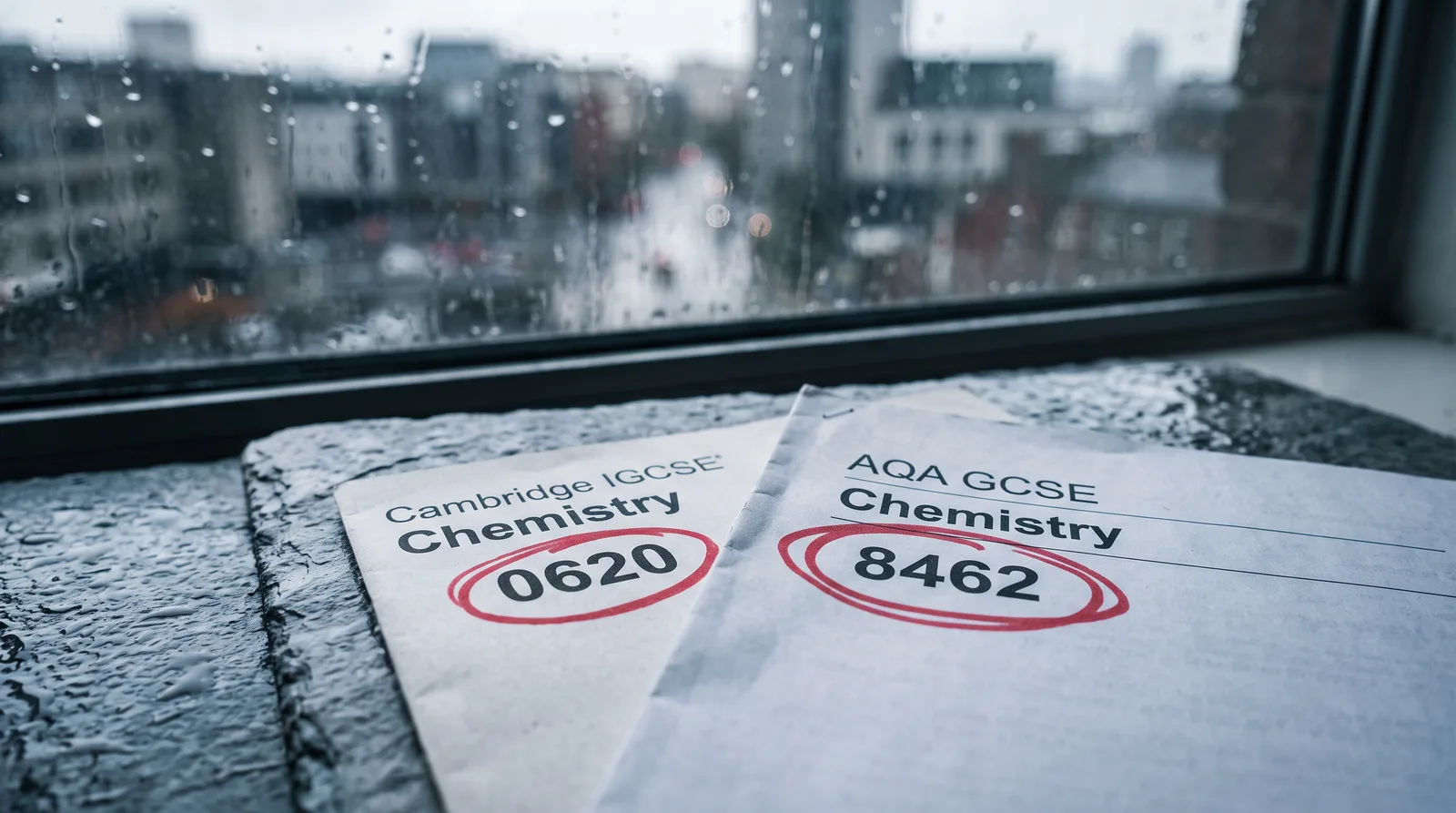
- Ask your school for your exam board and syllabus code. Cambridge IGCSE Chemistry is 0620 (or 0971 for the 9–1 version). AQA GCSE Chemistry is 8462. These codes are on every past paper.
- Download your syllabus directly from the exam board's website — not a revision site, the official source.
- Check past papers and mark schemes from your board. The mark scheme will show you exactly what language earns marks.
Why This Matters More Than You Think
Revision guides are written for specific syllabuses. A CGP AQA GCSE Chemistry guide is not the right tool for Cambridge IGCSE preparation. Using the wrong resource means you might be learning content that won't be tested, missing content that will be, and — most dangerously — learning the wrong mark scheme logic.
The exam doesn't reward hard work in general. It rewards precise answers to precise questions on a precise syllabus.
Once you know which qualification you're sitting and which exam board sets your paper, everything else — your revision resources, your past paper practice, your technique — can be pointed in exactly the right direction. That's when preparation starts to actually pay off.