Vision Statement vs. Mission Statement vs. Strategic Plan: What's the Difference and Why It Matters
TSThe Strategic Vault Academy · August 1, 2026 · 5 min read
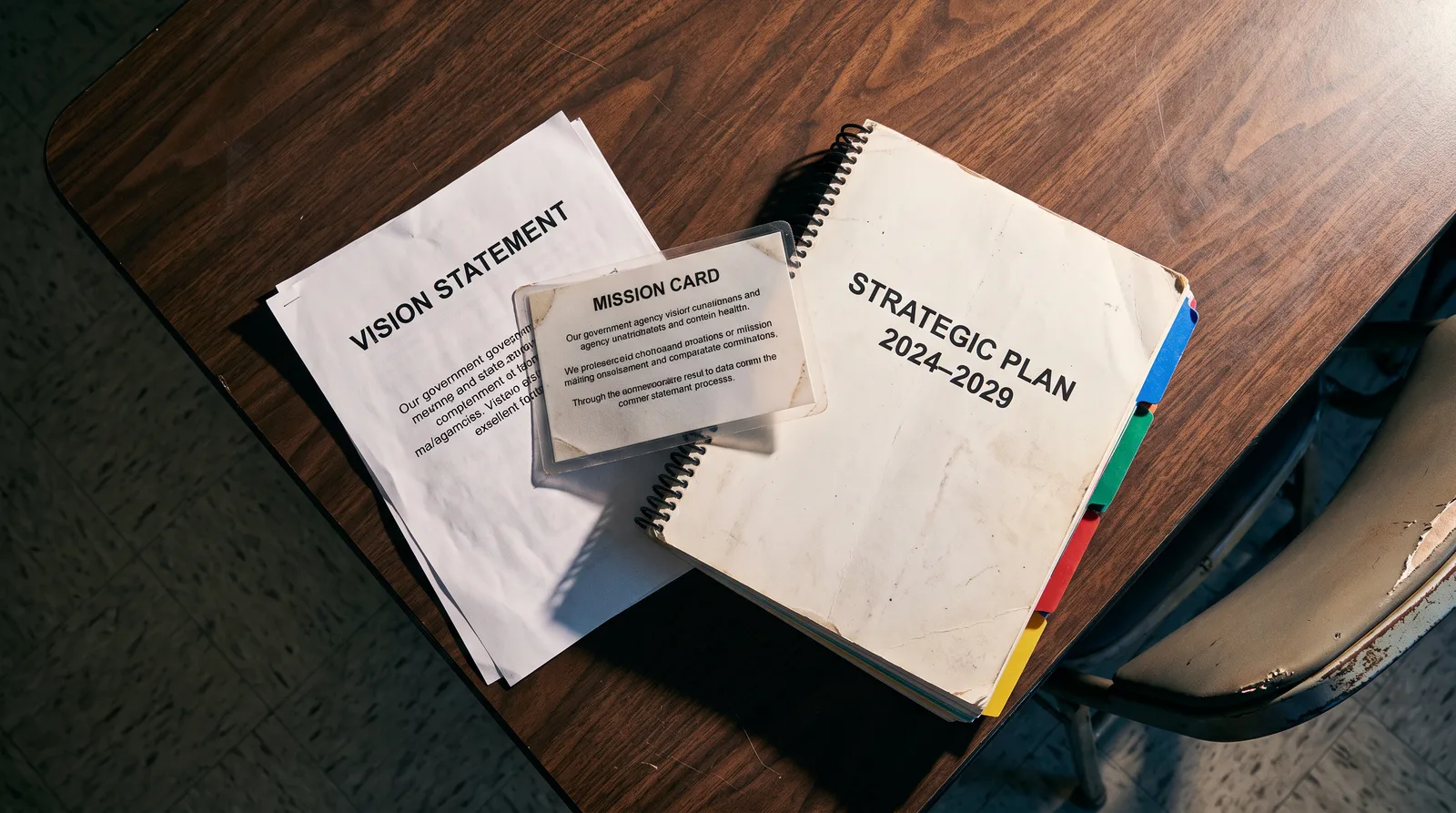
If I had a dollar for every time a public sector leader handed me a "strategic plan" that was really just a mission statement stretched across thirty slides, I'd have a very comfortable consulting budget. This confusion isn't a sign of bad leadership — it's a sign of a gap that nobody closed for you. Let's close it right now.
These three documents are not interchangeable. They do different jobs, they live at different altitudes, and they fail in different ways when you mix them up. Here's exactly what each one is, what it isn't, and how they connect.
The Vision Statement: Your Destination
A vision statement answers one question: What does a better future look like because our agency exists?
It is aspirational, long-horizon, and deliberately idealistic. It does not describe what you do today. It describes the world you are working toward — the condition you want to help create, sometimes ten or twenty years from now.
A strong vision statement is:
- Short — one to three sentences, memorable enough to say without reading it
- Future-facing — written in the present tense as if that future has arrived
- Inspiring but bounded — it's ambitious, not infinite; it speaks to your specific lane, not all of society
A weak vision statement reads like a corporate tagline with no geographic or functional anchor. If it could belong to any agency in any state, it's too vague to be useful.
Quick gut-check: Can your frontline staff tell you — without looking it up — what your agency's vision is? If not, the statement isn't doing its job.
The Mission Statement: Your Reason for Existing Today
A mission statement answers a different question: What do we do, for whom, and why — right now?
Where the vision is future-facing, the mission is present-tense. It describes your agency's current purpose, your primary stakeholders, and the core work you do to serve them. It's the answer you give when someone at a congressional briefing or a city council meeting asks, "So what does your department actually do?"
A strong mission statement is:
- Operational — it reflects your actual, funded mandate
- Stakeholder-specific — it names or clearly implies who you serve
- Distinct from your vision — reading both should feel like reading two different kinds of sentences
The most common mistake I see: leaders write a vision statement and then copy-paste a slightly wordier version of it into the mission field. Now they have two vision statements and zero mission statements — and their teams have no shared understanding of what they're accountable for today.
The Strategic Plan: Your Road Map Between the Two
If the vision is the destination and the mission is where you're standing, the strategic plan is the road map between them.
A strategic plan answers: Given who we are and where we want to go, what are the specific goals, priorities, and actions we'll pursue — and how will we know we're making progress?
A real strategic plan includes:
- Strategic goals — the three to five major outcomes you'll move toward over the plan period (typically three to five years)
- Objectives — measurable milestones under each goal
- Initiatives or strategies — the specific programs, process changes, or investments that will drive progress
- Performance indicators — how you'll measure success
- Accountability structures — who owns what, by when
Notice what's not in that list: the vision statement and the mission statement. Those belong in the plan's preamble as context — they are not the plan itself. The plan is the operational architecture that connects your current reality to your desired future.
Why Mixing Them Up Is So Costly
When these three documents blur together, here's what actually happens inside your agency:
Misaligned priorities. Without a clear mission, departments interpret their purpose differently and optimize for different things. Budget fights follow.
Wasted strategic planning cycles. If your "plan" is really a repackaged mission statement, you'll complete the planning process and still have no idea what to do on Monday morning. The document goes in a drawer.
Burned-out teams. When leaders can't connect day-to-day work to a larger strategic direction — because that direction was never clearly articulated — staff lose the sense of purpose that makes hard public sector work sustainable.
A Simple Diagnostic You Can Run Right Now
Pull up your agency's three documents — or whatever you're currently using in their place. Ask yourself:
- Does our vision describe a future state, or does it describe what we do?
- Does our mission describe what we do today, for whom, and why — or is it just an inspiring sentence?
- Does our strategic plan contain specific goals, measures, and owners — or is it mostly narrative?
If you answered "wrong" to any of those, you've just found your leverage point.
Knowing the difference is the first move. The second is building each document so they actually work together — so that your strategic plan traces a clear, credible line from your mission all the way to your vision. That's the work. And it's more learnable than most people think.
If you want a structured process for doing exactly that — including co-designed templates and a 30/60/90-day action plan — that's precisely what we work through inside The Strategic Vault Academy.

Want to go deeper than a blog post?
The Strategic Vault Academy
A nine-module coaching program that helps mid- to senior-level public sector leaders close the gap between strategic intent and operational reality — co-designing real artifacts, audits, and 30/60/90-day action plans along the way.
Start learning — $10 · 30 days access