

If you've had a course in your head for years and the reason it doesn't exist is a camera — the red light, the seventeen takes, the sound of your own recorded voice — this page is the one you've been waiting for. You never have to film yourself. Not for the lessons, not for the sales page, not once. And this isn't a workaround; it's arguably the better way to teach.
Why online courses ever required video in the first place
Video was never the point — it was the packaging. For twenty years, the only way to bottle a person's teaching and sell it while they slept was to record them. The entire industry that grew around that constraint — ring lights, editing software, "how to be confident on camera" courses about making courses — exists to solve a distribution problem, not a learning problem. AI teaching removes the constraint: your knowledge can now teach interactively without a recording of you performing it.
How a lesson works with no video in it
A TeachClub lesson is a conversation, not a broadcast. The AI teaches your material step by step — explaining, asking the student questions, adjusting when an answer shows confusion, adding short animated illustrations where a picture helps. When the student has a question of their own, the tutor answers it from your content, at any hour.
- It's active, not passive. Students respond every few moments instead of watching a talking head at 1.5× speed while checking their phone.
- It adapts. A confused student gets more steps; a quick one moves faster. A video plays at everyone identically.
- It answers. The single thing video can never do. Ask a video a question and it keeps talking.
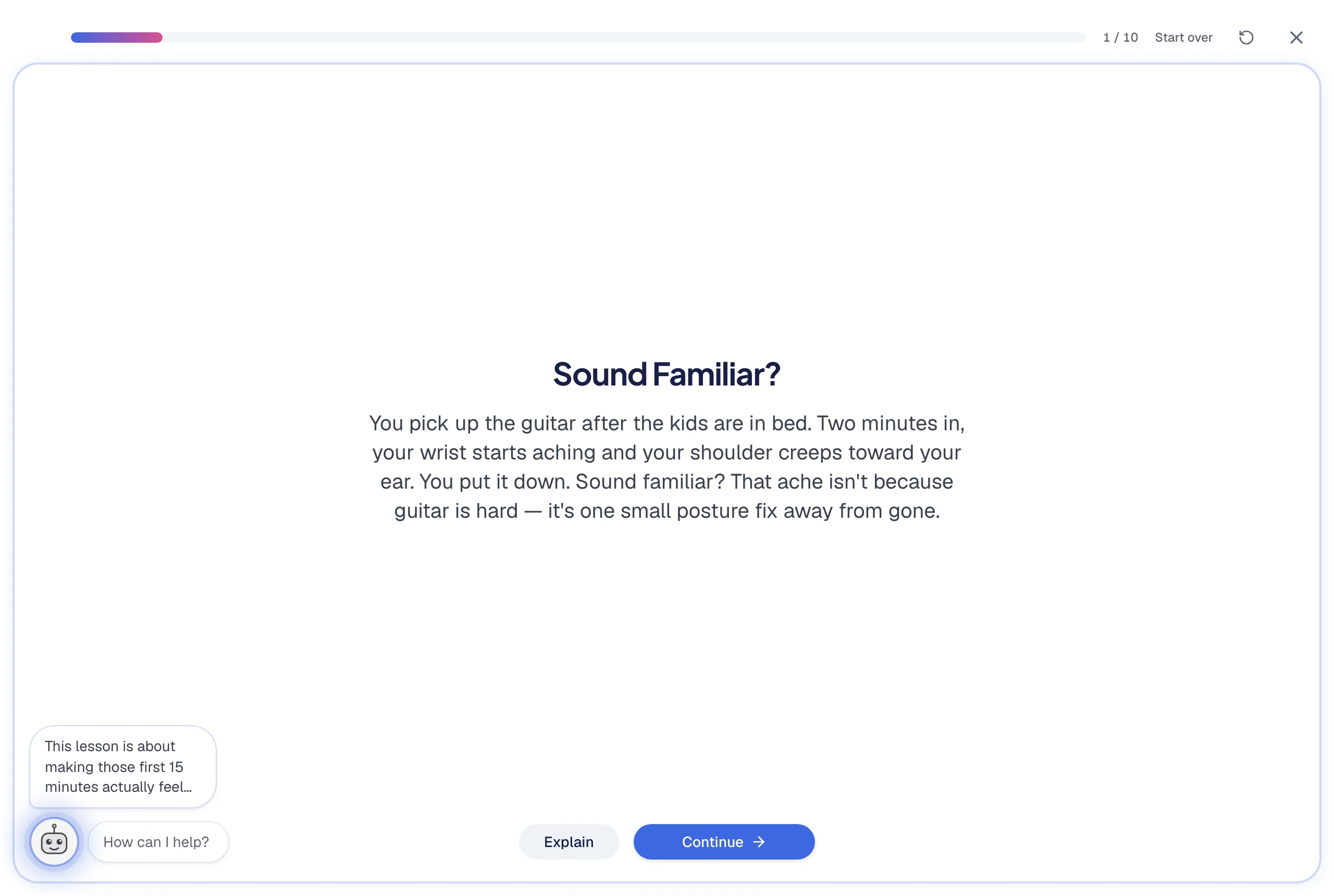
"But won't students think it's low-effort without video?"
Flip the comparison honestly. A camera-shy teacher's video course is a nervous person reading a script over slides — that's the realistic alternative, not a Netflix production. Against that, an interactive school that teaches personally and answers questions at 2am isn't the budget option; it's the premium one. What students actually judge you on is whether they're learning — progress, clarity, answers — and the student experience is built to deliver exactly those.

If you WANT video — it's welcome, on your terms
Some topics genuinely benefit from demonstration — a chord grip, a knead, a cast. If you have videos (even old phone clips), upload them: attach one to a specific lesson, tell the AI "show this first," and it builds the teaching around your footage. The point isn't that video is bad; it's that it's optional — a tool you reach for where it helps, not a gate you must pass to start.
What this unlocks, practically
- Start this week, not "someday when I'm ready to film." The build is an afternoon; there's no production schedule.
- Update freely. Changing a video course means re-filming. Changing your school means editing text — or just telling the assistant what to change.
- Stay consistent. Your worst-hair day and your best are identical to students. The school always shows up polished.
The bottom line
The camera killed more good courses than any lack of knowledge ever did — decades of expertise shelved because someone hated watching themselves. That tax is repealed. If your knowledge is real, it can teach tonight, in your words, with your name on it, and your face stays exactly where you like it: on your side of the screen.