

"I don't have time" usually means "I'm picturing the wrong business." The picture in most heads is the creator grind — filming, editing, posting, forever. A school is a different animal: you build a thing once, improve it occasionally, and the thing does the daily work. Here are the real hours, counted honestly.
Setup: one honest afternoon
- Minutes: describing what you teach and watching the AI build the school — curriculum, lessons, sales page, checkout.
- The real work (2–3 hours): reading the lessons and fixing what isn't you, uploading your materials so it teaches your way, setting your price.
- Minutes again: sharing the link with your first warm prospects.
Total: an afternoon, most of it the kind of work you'd enjoy — reviewing your own subject — rather than fighting software. Compare that line to "2–6 months of filming and platform assembly" and you've found where all the time you "don't have" actually went in the old model.
Why running it stays light: look at what you're NOT doing
| Job | Traditional course | TeachClub school |
|---|---|---|
| Delivering lessons | You (live) or your videos (re-filmed yearly) | The AI, on each student's schedule |
| Answering student questions | Your inbox, nightly | The tutor, from your material — only the personal ones reach you |
| Grading / checking progress | You | Automatic — quizzes and tracking built in |
| Enrollment, payments, receipts | You + three tools | Automatic |
| Marketing heartbeat | You | Still you — the honest column |

The weekly hours, counted
| Activity | Time | When |
|---|---|---|
| Check dashboard: sales, progress, anything odd | ~15 min | Coffee, twice a week |
| Student messages that need a human (the tutor fields the rest) | ~30–60 min | Whenever suits you |
| One marketing action: a post, a few personal messages, checking your ad | ~60 min | Any evening |
| Occasional improvement: sharpen a lesson, add an upload, adjust a price | ~30–60 min | Some weeks zero |
| Total | ~2–4 hours | None of it scheduled |
The unscheduled part matters as much as the total. There are no live sessions to show up for, no cohort start dates, no "office hours" — every one of those hours flexes around your job, your kids, your energy. The school never asks you to be somewhere at 7pm.
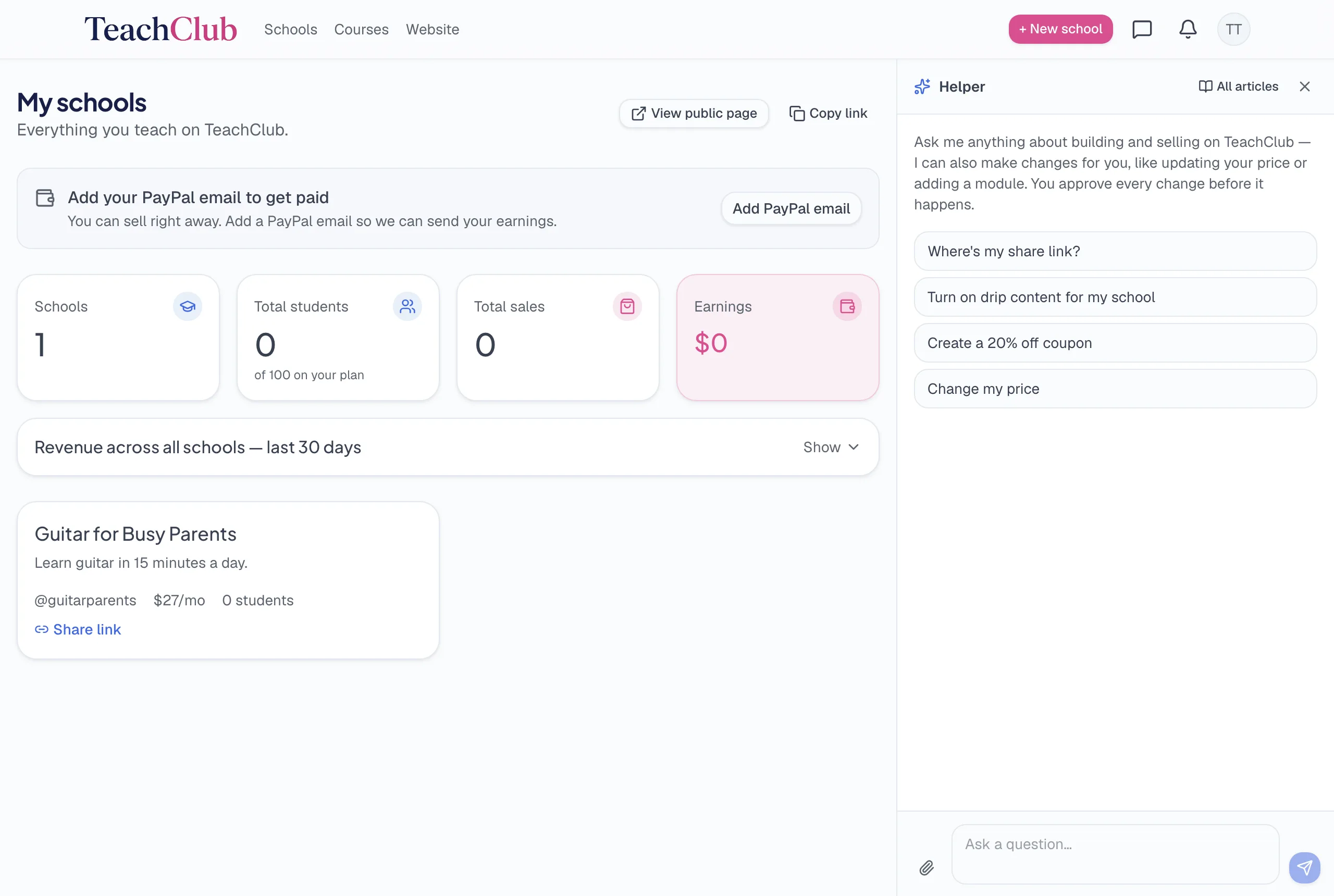
Running it around a full-time job
The 2–4 hours above fit in the margins you already have — two lunch breaks and one quiet evening. What makes it sustainable is permission to skip things at the start:
- Skip content creation entirely. No blog, no channel, no posting schedule. Your marketing is thirty personal messages, sent over weeks.
- Skip perfectionism on lessons. Ship the school at "good," let real student questions show you which lesson earns polish. Editing is minutes, or just ask the assistant.
- Skip community features until asked. Discussion boards and events are optional toggles — off is a fine launch state.
What growth actually adds
Here's the part that surprises people: going from 5 students to 50 barely moves your hours, because everything that scales with student count — teaching, questions, grading, payments — is the machine's job. What grows is a slightly busier message inbox and a much better dashboard. The traditional trade — more students, more of your evenings — is specifically the trade this model deletes.
The bottom line
You don't need spare time so much as one spare afternoon and a couple of flexible hours a week — the school covers the rest of the clock. The years of knowledge are already banked. The afternoon is the only new deposit required.